Water Is Disappearing and You Cannot See Where
Wet baseboards, a hissing sound in a wall, a bill that jumped for no reason, or a meter that keeps turning with every faucet closed. All of these point to a leak you cannot see. Call the 24/7 line and, while you wait, shut the house valve (ACWD says to turn it clockwise) and open one low faucet to drain the pressure.
Same-day leak location is the normal goal for active leaks, because water behind a wall keeps soaking insulation and framing every hour it runs. Our job is to answer one question quickly: where exactly is the water coming from, and how do we reach it with the least demolition?
Signs the Leak Is Hidden, Not Obvious
A dripping faucet is easy. These are the ones that need a locator.
Meter moves with everything off
Close every tap, stop the dishwasher and ice maker, then watch the meter dial. Movement means water is leaving the system somewhere.
Warm spot on a floor
A section of floor that stays warm can be a leaking hot line. Slab homes show this most clearly, which is covered on our slab leak repair page.
Musty smell, no visible stain
Mildew odor in a closet, cabinet or garage wall often means a slow supply or drain leak inside the cavity.
Sound of running water at night
A faint hiss or trickle when the house is quiet and nothing is on usually means a pressurized line is leaking.
Wet or sunken patch in the yard
Green, soggy or sunken ground between the meter and the house, with no sprinkler running, points to the service line.
Paint bubbling or drywall softening
Moisture is working its way out. The visible damage is often some distance from the actual leak.
Meter spinning with everything off?
Skip the guesswork. Call the 24/7 line and we will walk through the shut-off test together, then send a plumber with locating gear if the leak is real.
How We Pinpoint a Leak Without Tearing Into the House
| Tool | What it does | Where it falls short |
|---|---|---|
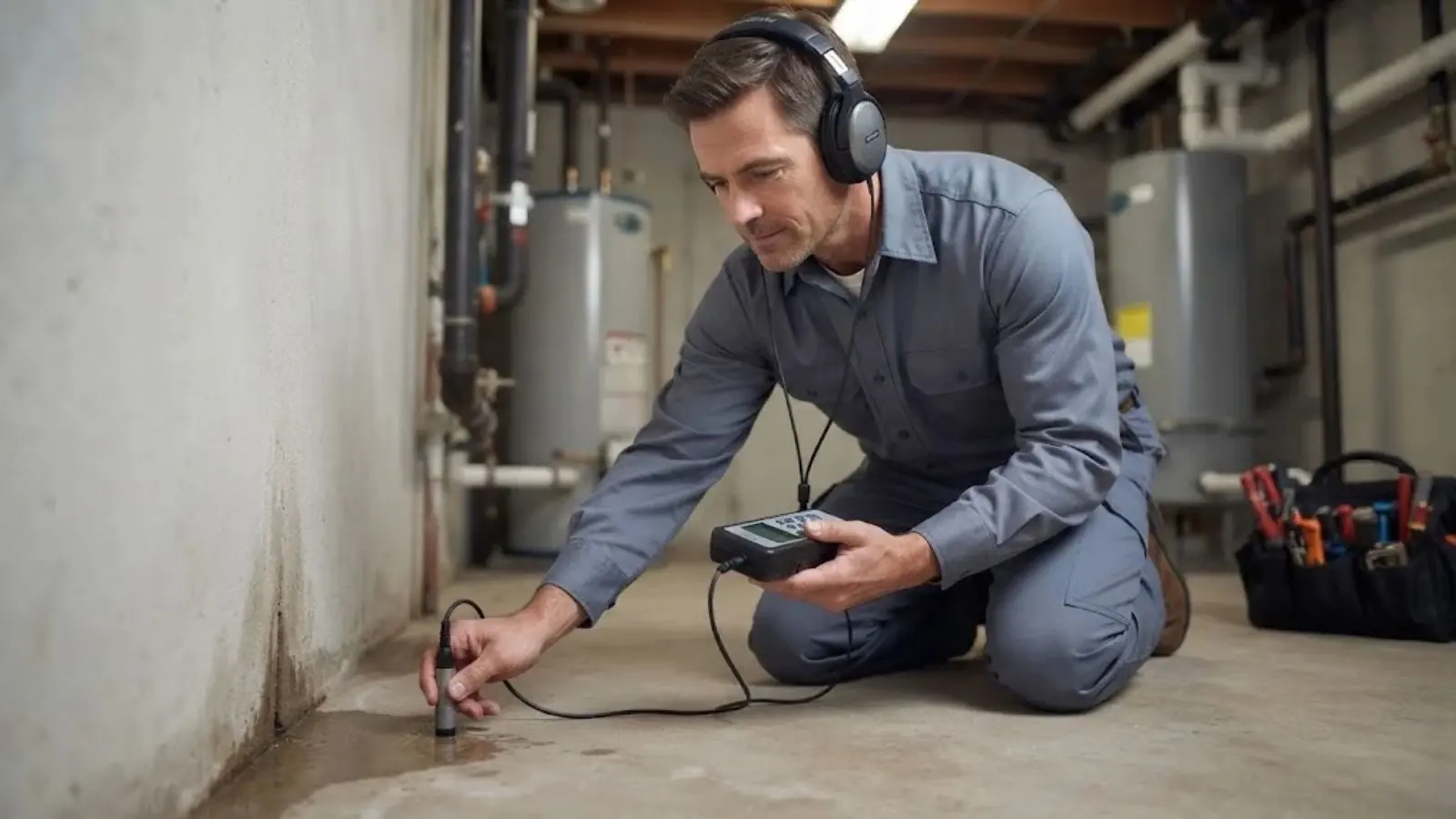
| Acoustic listening equipment | Picks up the sound pressurized water makes escaping a pipe, through floors, walls and soil. | Plastic pipe and very slow leaks are quieter, and traffic or running appliances add noise. |
| Thermal camera | Shows temperature differences from a hot line leaking or wet material cooling a surface. | It shows a pattern, not a depth. We confirm with a second method before cutting. |
| Moisture meter | Reads dampness in drywall, wood and subfloor so we can trace the wet area back to its source. | Old stains and fresh leaks read alike, so timing matters. |
| Pressure gauge and isolation | Capping sections of line and watching pressure tells us which branch is losing water. | It narrows the zone but does not give the exact spot on its own. |
Most locates combine two or three of these. One tool alone is a hint, two that agree is a location.
Ceiling, Wall and Attic Leaks
A brown ring on the ceiling or a wall that feels damp usually means water has already traveled. Pipe runs along a joist or inside a wall, so the stain can sit several feet from the actual leak. Place a bucket, move belongings out of the way and shut off the main house valve if the stain is growing.
We use moisture meters, thermal imaging and acoustic listening equipment to trace the water back to its source. The leak may be a supply line, a drain joint, a shower valve behind the tile or a heater connection in the attic. Finding the real source first keeps the drywall repair to one small, planned opening.
Water from a ceiling can also reach light fixtures and wiring. If water is dripping from a fixture, turn that circuit off at the panel and stay clear. After the leak is fixed, let the cavity dry fully before it is closed, since trapped moisture is how mildew starts.
Under-House and Crawlspace Leaks
Many older Union City homes sit on raised foundations, and the pipes run in the crawlspace where nobody looks. A leak there can soak insulation and subfloor for weeks before anything shows inside. Signs include a floor that feels soft, a musty smell near vents or a meter that moves when every fixture is off.
We trace these leaks by listening on the lines, checking the pipes along the run and looking at the underside of the floor. Supply lines, drain joints and old galvanized fittings are the usual suspects. Tell us if you have seen standing water under the house, because that changes how the visit is planned.
Buried Line Leaks Between the Meter and the House
A leak in the service line under a yard or driveway never shows on a wall. Clues are a soggy or sunken patch with no sprinkler running, a sudden drop in pressure or a bill that climbs while the house is empty. Close the house valve and see whether the meter stops, which tells you the leak is on the house side.
Pinpointing a buried leak matters because digging is the expensive part of the job. Acoustic equipment picks up the sound of escaping water along the pipe, and we mark the spot before anyone breaks ground. The line may need a spot repair or replacement, covered on our water line repair page.
Pool and spa plumbing is a separate system, so a pool that loses water is not always a house leak. We can check the supply and fill lines that connect to the house, and the pool company handles the shell and equipment.
Check a High Water Bill Before You Call Anyone
ACWD publishes a simple sequence, and it costs nothing to run. ACWD's AMI meters read remotely and can alert you to possible leaks, and continuous flow can trigger an email or text alert if you are signed up for them.
Run the overnight shut-off test
Turn off the house valve and leave it off overnight. Then check your usage on the ACWD portal in the morning.
Read the result
Usage while the valve was closed means the leak is likely outside, on the line between the meter and the house. No usage means the leak is inside the home.
Dye-test the toilets
Put a few drops of food coloring in each tank, wait 20 minutes without flushing, and look in the bowl. Color means a worn flapper is leaking.
Check outdoor irrigation
ACWD suggests checking sprinklers twice a year, once after winter and once in mid-summer. A stuck valve can run for days unnoticed.
Call if the numbers do not add up
If the toilets are clean and the meter still moves, the leak is in a wall, under a floor or in the ground. That is when locating equipment earns its keep.
Who Owns the Pipe on Either Side of Your Meter
ACWD is responsible for pipes on the street side of your water meter. You are responsible from the meter inward to the house. That boundary decides who gets the call: if water is surfacing near the meter on the street side, contact ACWD Operations at (510) 668-6500, and if it is on your side, it is yours to locate and fix.
Our locating work starts at the meter for that reason. We can tell you which side of the line the leak sits on before anyone digs.
Locating a leak is the first step. The repair itself follows the California Plumbing Code, which is based on the Uniform Plumbing Code (UPC), so ask for the repair plan in writing: which pipe, which fittings and whether the work needs a permit.
Source type: Alameda County Water District (ACWD) customer FAQ and leak pages
What to Have Ready When You Call
- Where the water or damage shows up, and since when.
- What the meter does with every fixture and appliance off.
- Whether you ran the overnight shut-off test and what the ACWD portal showed.
- Whether the house has a slab, a crawlspace or a basement, and roughly how old the plumbing is.
- Where your main house valve is, and whether it closes fully.
Once the leak is located, repairs run from a single fitting to a section of line, and a long run of failing pipe may point to repiping. We also work in Fremont and across the Tri-City area, see emergency plumber in Fremont.
Leak Detection Questions
Yes. The line is answered 24/7, and an active leak is treated as urgent any hour of the day. Shut the main house valve first, then call, and we will tell you what to check while a plumber is on the way.
Use ACWD's overnight shut-off test. Close the house valve and leave it overnight. Usage on the portal during that time points to a leak outside, no usage points to a leak inside.
About 20 minutes. Add dye to the tank, do not flush, and check the bowl. Color in the bowl means the flapper is leaking.
Usually not to find it. Acoustic, thermal and moisture tools locate the leak from the surface. Opening is for the repair, and it is kept to the smallest area that reaches the pipe.
ACWD is responsible for pipes on the street side of the meter. The owner is responsible from the meter inward. If you are unsure which side the leak is on, we can locate it first.
Run the shut-off test and the toilet dye test, and check irrigation. A running toilet is the most common silent cause, followed by a buried line or a leak inside a wall.