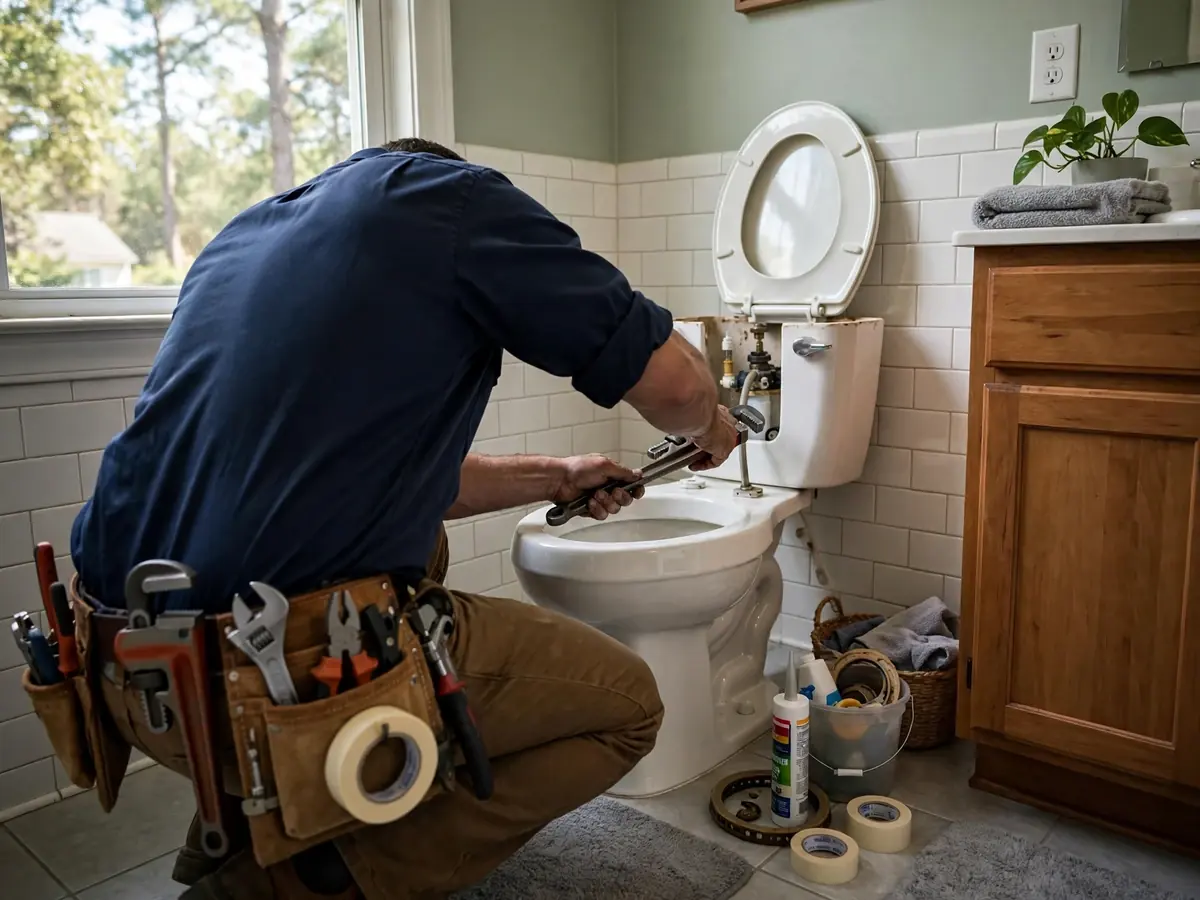
The toilet is overflowing right now
Do not flush again. Reach behind the bowl, turn the chrome stop valve clockwise until it seats, and take the lid off the tank. If the valve is stuck or the water keeps coming, shut the whole house off at the main valve (clockwise, per ACWD).
Overflow water from a toilet is contaminated, so keep children and pets out and use gloves for cleanup. A plunger with a flange (the soft rubber sleeve) is the right tool for a bowl, and a flat cup plunger is not.
If a second toilet, a tub or a floor drain also gurgles or backs up, the blockage is probably in the main line, not the bowl. That is a sewer job, and the plunger will not help.
What the toilet is telling you
Runs or hisses after flushing
Usually a worn flapper that no longer seals, a chain with too much slack, or a fill valve that will not shut off. Water is slipping into the bowl all day.
Refills by itself every so often
Called a phantom flush. The flapper leaks just enough to drop the tank level until the fill valve kicks in.
Weak or half flush
Check the tank water line against the mark on the overflow tube, then the chain length. If both are fine, mineral buildup in the rim jets or a partial clog is the likelier cause.
Water around the base
The wax ring or flange has failed, or the closet bolts have loosened. Water behind the toilet can also be a cracked supply line or a sweating tank, so find the source first.
Gurgles after you flush
A partial clog or a venting problem. If the bathroom sink or tub also burps when the toilet drains, the line past the toilet needs a look.
Toilet leaking through the floor?
Describe where the water shows up and we will help you decide whether to shut the stop valve or the whole house off.
How a toilet repair visit goes
Find the water source
We dry the base and tank, then watch where the first drop appears. Supply line, tank bolts, gasket and wax ring all look alike until the area is dry.
Test the tank
Dye in the tank, no flush, wait. ACWD suggests 20 minutes, and color in the bowl proves a silent leak at the flapper or flush valve seat.
Replace the failing parts
Fill valve, flapper, chain, supply line or tank gaskets. We prefer swapping the fill valve and flapper together, because both wear at the same pace.
Reset the seal if needed
To fix a leaking base we pull the toilet, scrape the old wax, check the flange and fit a new ring. A flange sitting below the finished floor gets a spacer or extender.
Flush and test
We run several flushes and watch the base for seepage before we call it done.
Repair the toilet or replace it
Parts are cheap compared with a fixture, but a bad toilet is a bad investment however many parts you add.
| Situation | Usually repair | Usually replace |
|---|---|---|
| Running tank, weak flush, sweating | Fill valve, flapper, gaskets | Only if the tank itself is cracked |
| Leaking base | New wax ring and bolts | If the bowl or flange area is cracked or the floor is soft |
| Cracked tank or bowl | No lasting repair exists | Replace, and do not seal cracks with caulk |
| Old, high-volume model | Repair if it works and you are content | Replace when parts are hard to find and water use matters |
Toilets from before the mid-1990s use much more water per flush than a current model.
Union City water and the toilet in your house
The 2025 California codes adopted by Union City cap new residential toilets at 1.28 gallons per flush, so any replacement installed here will be a 1.28 gpf model. Choose by flush performance, since the lower volume gives a weak design less room to hide.
Your water is also moderately hard (ACWD reports 120 to 160 ppm for the blended supply, average 138, about 8 grains per gallon). Scale builds up in the fill valve seat and the rim jets, so a toilet that flushes weakly may need descaling before you condemn it.
Source type: Alameda County Water District water quality report and 2025 California Green Building Standards Code
Quick checks that save a trip
- Drop food coloring in the tank. If it shows in the bowl after 20 minutes without flushing, the flapper or its seat is leaking.
- Watch the tank level. If water spills into the overflow tube, the float is set too high or the fill valve is failing.
- Note which fixtures react. A toilet that bubbles when the washer drains points to the main drain line, so sewer line cleaning is the right call.
For repeat clogs, see our guide to a toilet that keeps clogging.
Installing a new toilet, step by step
A swap starts with the rough-in, the distance from the wall to the drain center. Twelve inches is the common measurement, but older homes sometimes have 10 or 14, and the new bowl has to match. We also check the flange height, the subfloor condition and the angle stop valve before the old toilet comes out.
A new wax ring, fresh closet bolts and a braided supply line go in with the new bowl. The bowl is set straight, snugged down evenly (porcelain cracks when one side is overtightened) and caulked at the floor so that a future leak is visible rather than hidden.
Ask the city Building Division whether a fixture replacement in your home needs a permit. The city says repairing fixtures does not, but replacing or rearranging them can.
Toilet questions we hear most
Yes. The line is answered 24/7, including nights, weekends and holidays, and overflows, leaking bases and water on the floor are treated as emergencies. Tell the plumber what you see and shut the stop valve behind the bowl.
Nine times in ten it is the flapper or the fill valve. The flapper lets water slip into the bowl, and the fill valve keeps topping up the tank. Both are inexpensive parts, and swapping them together is the usual fix.
Look for water around the base after a flush, a rocking bowl, or a sour smell that does not go away. Once the ring leaks, the subfloor can soak without showing it, so do not wait for a stain.
A good one is. The California standard for new toilets is 1.28 gallons per flush, and well-designed bowls clear waste without a second flush. Bargain models are the ones that struggle, so choose by flush performance, not only price.
Yes. We use a closet auger that clears the bowl without scratching the porcelain. If the whole house is slow, we move on to the drain line.