No hot water or a leak at the tank
The right first step depends on what you are looking at. Cold water from the hot tap is annoying but rarely dangerous. Water spreading on the floor is not, so close the cold supply to the heater and cut power or fuel before anything else.
Our crew works nights and weekends, and same-day diagnosis is usual when the call comes in early enough. Many failures are single parts, so a repair visit often restores heat on the first trip. If the tank itself is rusted through, we say so plainly and talk through a replacement.
Never relight a gas pilot if you smell gas. Leave the building, call 911, then PG&E at 1-800-743-5000.
What your heater is telling you
Lukewarm or runs out fast
On electric units, a dead lower element or thermostat. On gas, a weak burner or heavy sediment layer at the bottom of the tank.
Rumbling or popping
Scale on the bottom of the tank traps steam bubbles under it. This is common with hard water and responds to a flush if caught in time.
Rust-colored hot water
Usually a spent anode rod or a corroding tank. If only the hot side is discolored, the heater is the likely source.
Pilot will not stay lit
A worn thermocouple, a dirty pilot orifice, or a draft problem at the flue. Each has a different cure.
Dripping at the side or top
A loose fitting, a failing T&P relief valve, or the expansion of water in a closed system. Find the source before assuming the tank.
Water around the base
A leaking drain valve is a cheap fix. Water from the tank body is not repairable, see replacement.
Heater acting up?
Tell us the symptoms and the fuel type. We will tell you whether it sounds like a part or a tank.
What goes wrong on gas, electric and hybrid units
| Type | Common failures | What we check first |
|---|---|---|
| Gas | Thermocouple, pilot assembly, gas control valve, venting draft | Flame quality, flue draft and gas shutoff |
| Electric | Heating elements, upper or lower thermostat, high-limit reset | Power at the terminals, element resistance and thermostat settings |
| Hybrid heat pump | Condensate drain, air filter, fan and sensors, element backup | Airflow, drain line and mode settings |
| All tank types | Anode rod, T&P relief valve, drain valve, sediment | Leaks at fittings, discharge line, tank drain |
Heat pump models have sealed refrigerant systems. If the fault is in the sealed side, the discussion moves toward warranty and replacement.
Hard water in Union City and what it does to a tank
The Alameda County Water District reports that Union City receives a blended supply with hardness between 120 and 160 ppm, averaging 138 ppm, or about 8 grains per gallon. That is hard water by common scales. Minerals settle at the bottom of a tank, coat electric elements and insulate gas burners from the water.
The practical payoff is a simple routine. Flushing a tank once a year and checking the anode rod can delay the kind of failure that ends a tank early. Check your ACWD water quality report to see your own neighborhood's number.
Repairs such as relief valve and thermostat work follow the California Plumbing Code, which is based on the Uniform Plumbing Code (UPC) and the manufacturer's instructions. If a unit needs repeated repairs, ask whether the installation itself meets that standard before you pay for another part.
Source type: Alameda County Water District 2025 water quality report
What a repair visit looks like
Isolate
We close the water, power or gas as needed and protect the floor.
Diagnose
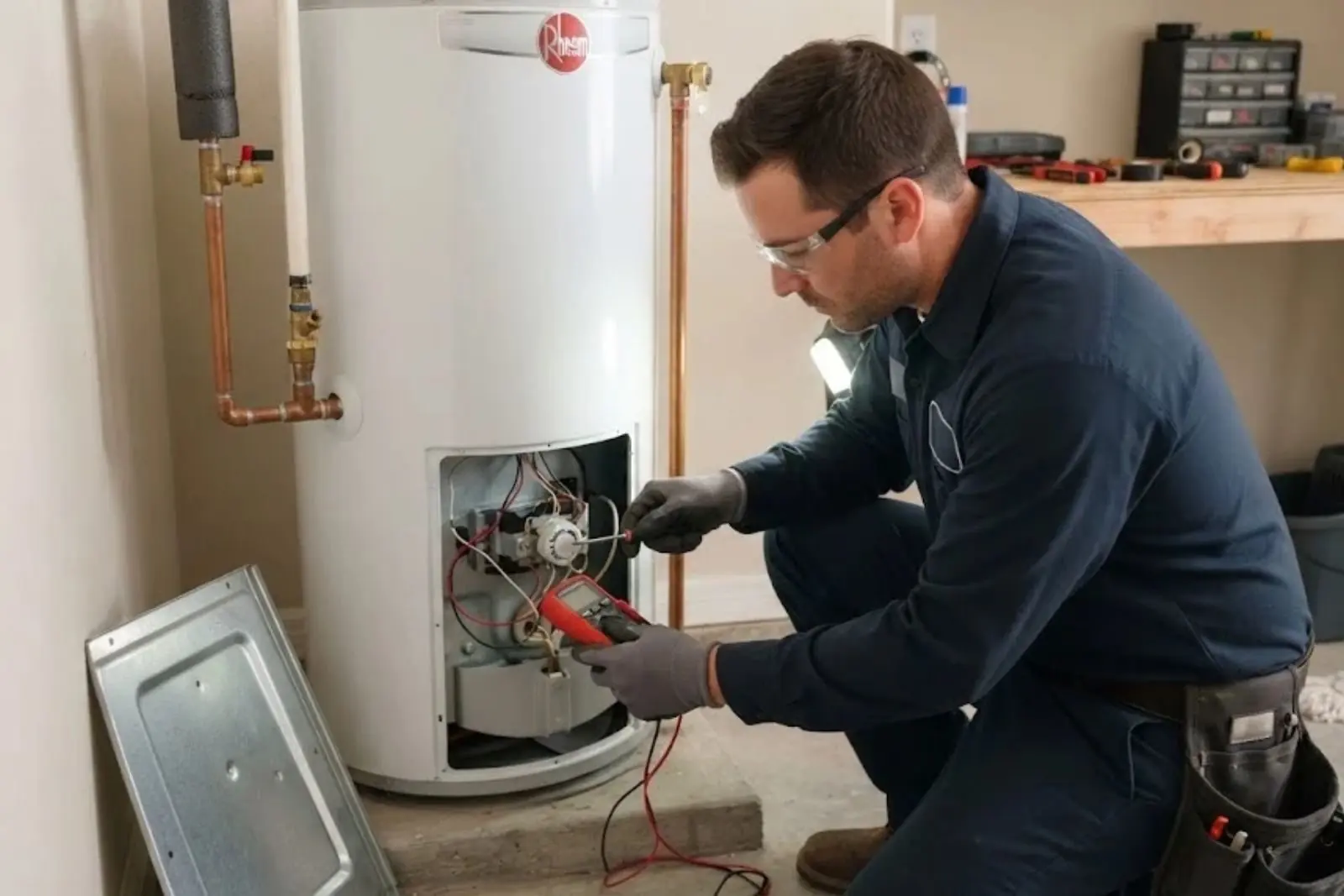
A meter, a manometer on gas units and a visual check at fittings and the relief valve narrow the fault down.
Quote the repair
You hear the cause, the part and the trade-off against a new unit before any work starts.
Repair and test
After the part is swapped, we test heat, flame or power, check for leaks and confirm the relief discharge line.
Quick checks that save time
- Is the breaker tripped, or is the gas control set to pilot or on?
- Is the red reset button on an electric unit pressed in?
- Where exactly is the water, and is it hot or cold?
- Note the brand, tank size and the label's age.
- Is the relief valve discharge pipe dripping?
If you are weighing a repair against a swap, replacement options are laid out on their own page. Leaks elsewhere in the house may need leak detection to trace.
The part that decides how long a tank lasts
The anode rod sacrifices itself so the tank liner does not. When the rod is consumed, corrosion moves to the steel. Checking it every few years with a socket and a breaker bar is cheap, and replacing it can add years to a tank. We say honestly when it is too late.
We repair heaters across Union City and the Tri-City area, including Fremont, see emergency plumbing in Fremont. Heavy sediment on a worn tank may point to water softening as a longer-term fix.
Water heater repair questions
Yes. The line is answered 24/7, including nights, weekends and holidays. For a leak we walk you through shutting off water and power or gas first, then plan the repair visit, often the same day.
Mineral scale on the bottom of the tank traps steam bubbles. With Union City's hardness averaging about 8 grains per gallon, sediment is a common cause. A flush often fixes it if the scale is not too thick.
If the water is lukewarm on an electric unit, one element or thermostat is likely out. A plumber checks power and resistance at the terminals to tell which one.
It can be. The valve is a safety device, so a dripping one should be checked soon. The cause can be a bad valve or excess pressure in the system, and each needs a different fix.
Yes for most external parts such as condensate drains, filters and electrical faults. Sealed refrigerant faults usually point toward the manufacturer's warranty or replacement.
Follow the label on the unit, and never relight if you smell gas. If the pilot will not stay lit, the thermocouple or draft is likely at fault and a plumber should look.