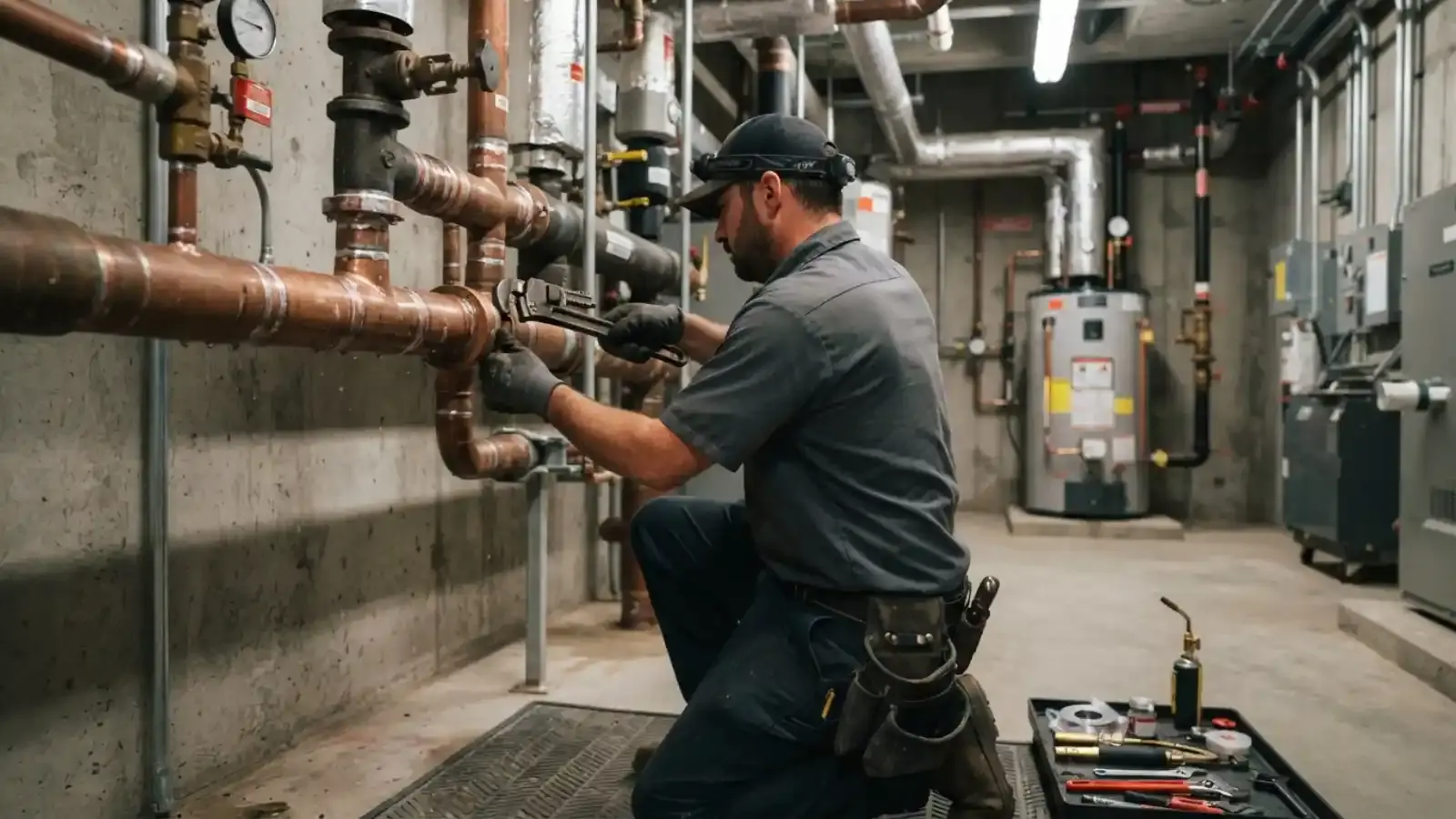
When a drain backs up in the middle of service
Stop adding water. Close the kitchen, stop the dish machine and turn off the sinks that feed the affected drain. A floor drain that rises is usually a sign the building drain or a grease line downstream is blocked.
Move product, paper goods and cash off the floor, and mark the wet area. Take photos for your records and any insurance claim, and call the 24/7 line before the flood spreads to the dining room or sales floor.
Do not pour chemicals into a blocked commercial drain. They sit in the pipe and are hazardous for whoever opens it next.
Restaurants, retail and tenant spaces
Union Landing is known for dining and entertainment, and the businesses around it include food service and retail, which have different plumbing profiles. Restaurants lean on grease handling, floor drains, three-compartment sinks and prep sinks. Retail spaces mostly need dependable restrooms, hose bibs, mop sinks and a clean, vented drain.
We work in occupied spaces, so we plan around service hours when we can and keep the work area tidy. The line is open when your doors are closed.
Grease trap and interceptor service
Commercial kitchens send fat, oil and grease into the sewer unless a trap or interceptor catches it. Neglect is the most common cause of restaurant drain backups.
Know which device you have
A small trap sits under or beside the sink and holds a few gallons. A large interceptor is buried outdoors or in the floor and holds hundreds.
Clean on a schedule
The trap works only while it has room. When the grease layer fills, the unit lets fat pass into the lines. Many kitchens clean small units weekly or monthly and have the outdoor unit pumped by a hauler.
Inspect the baffles and lids
A cracked baffle or a missing gasket lets grease slip through and let odors out. We check the internals each time we open it.
Jet the line after it
Grease that has already coated the pipe wall needs hydro jetting to remove it, since cabling only punches a hole.
Ask USD and your city what grease rules apply to your kitchen, because pumping frequency is set by local rules and by how much you cook.
Drain or grease line failing?
Call the 24/7 line, tell us the business type and the fixture, and we will plan the visit around your service.
Floor drains, restrooms and flushometers
Floor drains that rise
A floor drain is the lowest point in the system, so it shows a main line blockage first. Strainers also catch mop debris, so we clean and trap-prime them.
Dry traps and odors
A floor drain trap evaporates when it sees no water. A sewer smell in a seldom-used room is often a dry trap, and it is fixed by adding water or a trap primer.
Flushometer toilets
Wall-mounted valve toilets that flush on a button need clean diaphragms and proper supply volume. Weak flushes or constant running usually point to a worn diaphragm or an adjustment.
Mop sinks and hose bibs
These are heavy-use fixtures that wear out. Replacing a seat or stem often costs less than a leak.
Backflow testing and the ACWD annual rule
ACWD runs a cross-connection control program for Union City, and the law requires that backflow prevention assemblies be tested by a certified tester at least once a year. Restaurants with carbonated drinks, irrigation, fire lines or boilers are common candidates.
ACWD keeps a list of approved backflow testers and a backflow office at 510-668-6584. A failed assembly has to be repaired or replaced and retested, so book the test early.
Commercial plumbing is built and inspected to the California Plumbing Code, which is based on the Uniform Plumbing Code (UPC), and some systems add their own requirements, such as grease interceptors and backflow assemblies. Ask your landlord or the city which rules apply to your space before ordering any work.
Source type: Alameda County Water District backflow prevention program
Storm drains and parking-lot catch basins
Storm drains carry rainwater, and nothing else should enter them. A mop bucket dumped in a lot catch basin, or kitchen wash water hosed into a gutter, is a pollution problem that follows the business owner. Wash water goes to the sanitary drain, not the storm drain.
The Fremont station averages about 16 inches of rain a year (NOAA normal), and most of it falls in a short wet season. Leaves and debris clog catch basins just when they are needed, so clear them before the first big storm. Standing water that never drains near a catch basin can signal a failing underground line, which leak detection can trace.
Tenant or landlord: who pays for what
Your lease decides, and these are the common defaults to check against it.
| Item | Usually the tenant | Usually the landlord |
|---|---|---|
| Fixtures inside the suite | Yes, faucets, toilets, sinks | Sometimes for building-wide risers |
| Grease trap or interceptor | Yes, for restaurant uses | Rare, unless shared |
| Floor drain and branch lines | Often, up to the common line | The shared building drain |
| Backflow assembly | Depends on lease and who owns the service | Often the owner, if on the building service |
| Sewer lateral to the main | No | The property owner, from the building to USD's main |
USD says the owner is responsible for the entire sewer lateral to the main. If your lease says otherwise, get it in writing.
A short list for managers and owners
- Know your shutoffs. Label the main water valve, the fixture valves and the grease device lids, and keep staff trained.
- Set a grease schedule. Write down the last pumping date and the next one.
- Test backflow on time. Keep the annual report on site.
- Run the floor drains. Add water to little-used drains monthly.
- Watch for slow drains. They are the early warning, and an early cleaning beats a closed dining room.
For repeating blockages, a sewer camera inspection shows what is happening inside the line. We also take calls across Fremont and the Tri-City area.
What to do before we arrive
For an after-hours call, a few minutes of action protects the space and the people in it.
- Close the water valve. Shut the valve serving the affected area or the main, and tell staff where it is.
- Keep people clear. Block off wet floors and restrooms that are backing up, and do not run more water down the drain.
- Do not pour chemicals. Drain chemicals can splash and complicate the work, so leave the clog as it is.
- Contact the property manager. If you lease the space, the landlord may own the line, so tell them and photograph the damage.
Commercial plumbing questions
Yes. The line is answered 24/7, including nights, weekends and holidays, and a restaurant drain backup or restroom flood gets handled as an emergency. Tell the plumber the type of business and the fixture, and what you have already shut off.
It depends on the size of the unit and how much you cook. Small under-sink traps are often cleaned every few weeks, and large outdoor interceptors are pumped by a hauler on a longer schedule. Ask USD and the city what applies to your kitchen.
ACWD requires a certified tester, and it keeps a list of approved testers. The test is annual. Ask any tester to show their certification and ACWD registration before the work starts.
Floor drains sit at the lowest point, so a blocked line downstream raises water there first. A grease buildup or a blocked main line is the usual cause, and a camera inspection finds it.
Your lease governs. Fixtures inside a suite are commonly the tenant's, and shared building lines belong to the landlord. USD makes the property owner responsible for the sewer lateral.
Where the problem allows it, yes. Non-urgent work can be planned for slow hours, and emergencies are handled when they happen.