How installation differs from replacement and repair
Replacement swaps a failed tank in the same spot, using the same connections. Repair fixes a part on a working or partly working unit. Installation starts from a blank slate. A new location, a change in fuel, or a new building means someone must plan the venting, the supply lines, the drainage and the code items before the first fitting is made.
That planning is where the money and the headaches live. A unit moved from a garage to a hall closet needs different venting. A switch from gas to a heat pump needs a circuit and a condensate drain. Plan these before you buy the unit, not after it arrives.
What the location has to provide
Location and clearances
Gas units need combustion air and clearances from combustibles. Heat pump units need open air volume or ducting. Garage installs have extra rules for ignition source height.
Venting
Atmospheric gas units use a draft hood and a flue that rises and terminates correctly. Sealed-combustion and condensing models vent through plastic pipe to the side or roof.
Gas line
The line must be sized for the total gas load, with a shutoff, a sediment trap and a flexible connector. A longer run or an added appliance can call for a larger pipe.
Electric service
Electric and heat pump units need a dedicated circuit sized to the nameplate. An older panel may limit the choice.
Sketching out a new install?
Give us the location, the fuel and the model you are considering. We will tell you what the site needs.
Union City's code year and the Building Division
Union City adopted the 2025 California codes, including the Plumbing and Mechanical codes, effective January 1, 2026. The City states that a building, plumbing, mechanical and electrical permit is needed for most types of construction. Planned installs, especially new locations or fuel changes, are the sort of work that tends to be inspected.
The practical payoff is a short phone call. Before you commit to a plan, call the Building Division at 510.675.5313 and ask how your project is handled. Inspection requests go through 510.487.0711, and the line has limited slots each day, so calling early helps.
Water heater installation follows the California Plumbing Code, which is based on the Uniform Plumbing Code (UPC), including the pressure relief valve, discharge piping and seismic strapping required by California law. Ask what will be included, because each item is a code requirement, not an upsell.
Source type: City of Union City Building Division pages
The parts that make an install pass
| Item | Why it is there | What we look at |
|---|---|---|
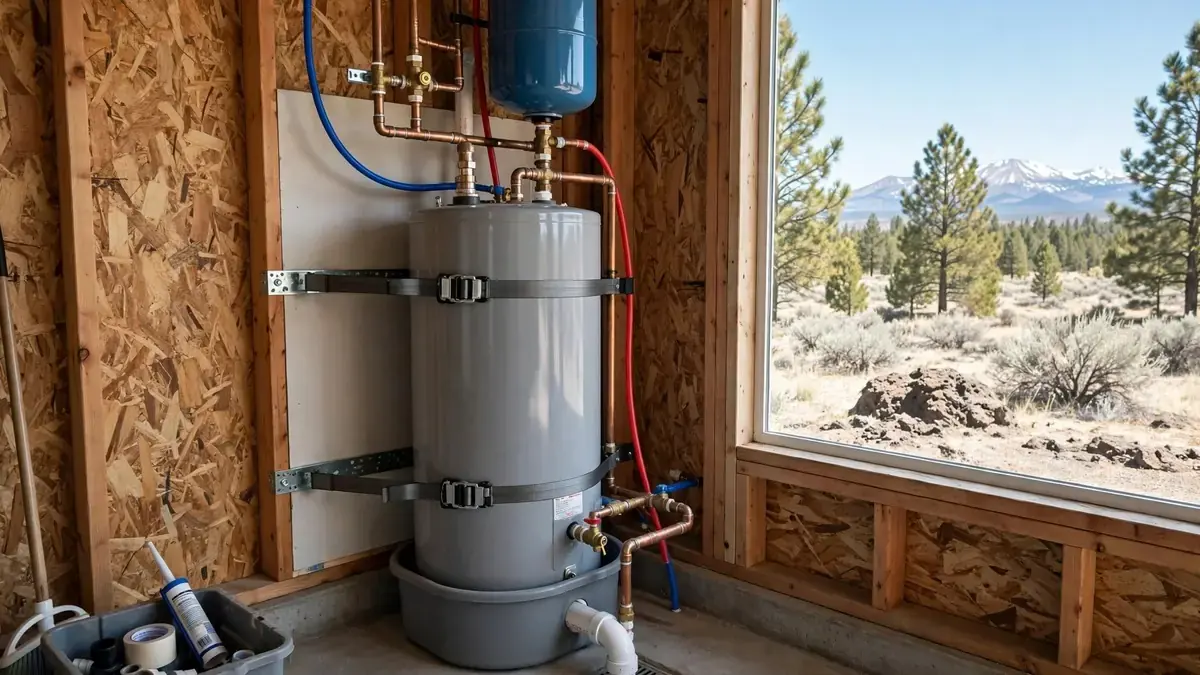
| Seismic strapping | California Health and Safety Code 19211 requires bracing against earthquake motion | Strap placement, anchor points and wall backing |
| Drain pan | Catches a failure when the heater is above living space or finished floors | Pan size, drain line and discharge point |
| Expansion tank | Absorbs thermal expansion in a closed system | Whether a check valve or regulator closes the system |
| Pressure regulator | Protects the heater and fixtures from high supply pressure | Gauge reading and regulator condition |
| T&P relief line | Safe discharge of a relief event | Pipe size, slope and termination point |
What shapes an installation quote
From plan to a hot tap
Site visit or detailed call
We confirm location, clearances, existing venting, gas and electric capacity.
Scope and code review
You get the list of code items and the permit approach before work starts.
Rough-in
Supply, gas, vent and electrical are run or modified.
Set and strap
The unit is set in the pan, strapped and connected.
Test and inspection
We test for leaks, flame or power, relief discharge and expansion, then support the inspection.
If you are replacing a working unit with an upgrade in size or fuel, see tankless options before you choose. If your tank has already failed, go to water heater replacement. Our crew also works in Fremont, see Fremont plumbing.
Water heater installation questions
Replacement swaps a failed tank in place. Installation covers a new location, a fuel change or a new build, which means new venting, supply, gas or electric service and drainage.
If a check valve or pressure regulator makes your plumbing a closed system, thermal expansion has nowhere to go and an expansion tank is the usual answer. A plumber can check your system during the visit.
Often yes, but each location has its own venting, clearance and combustion air rules. Garage gas units have additional ignition source rules. Call before buying the unit.
The City of Union City says a plumbing permit is needed for most construction. Ask the Building Division at 510.675.5313 how it applies to your project.
Yes. California Health and Safety Code 19211 requires bracing, anchoring or strapping of new and replacement water heaters.
Yes. The site needs a dedicated circuit, a condensate drain and space or airflow around the unit. A BayREN incentive of 1,000 dollars may apply when it replaces a gas heater for an Ava Community Energy customer.