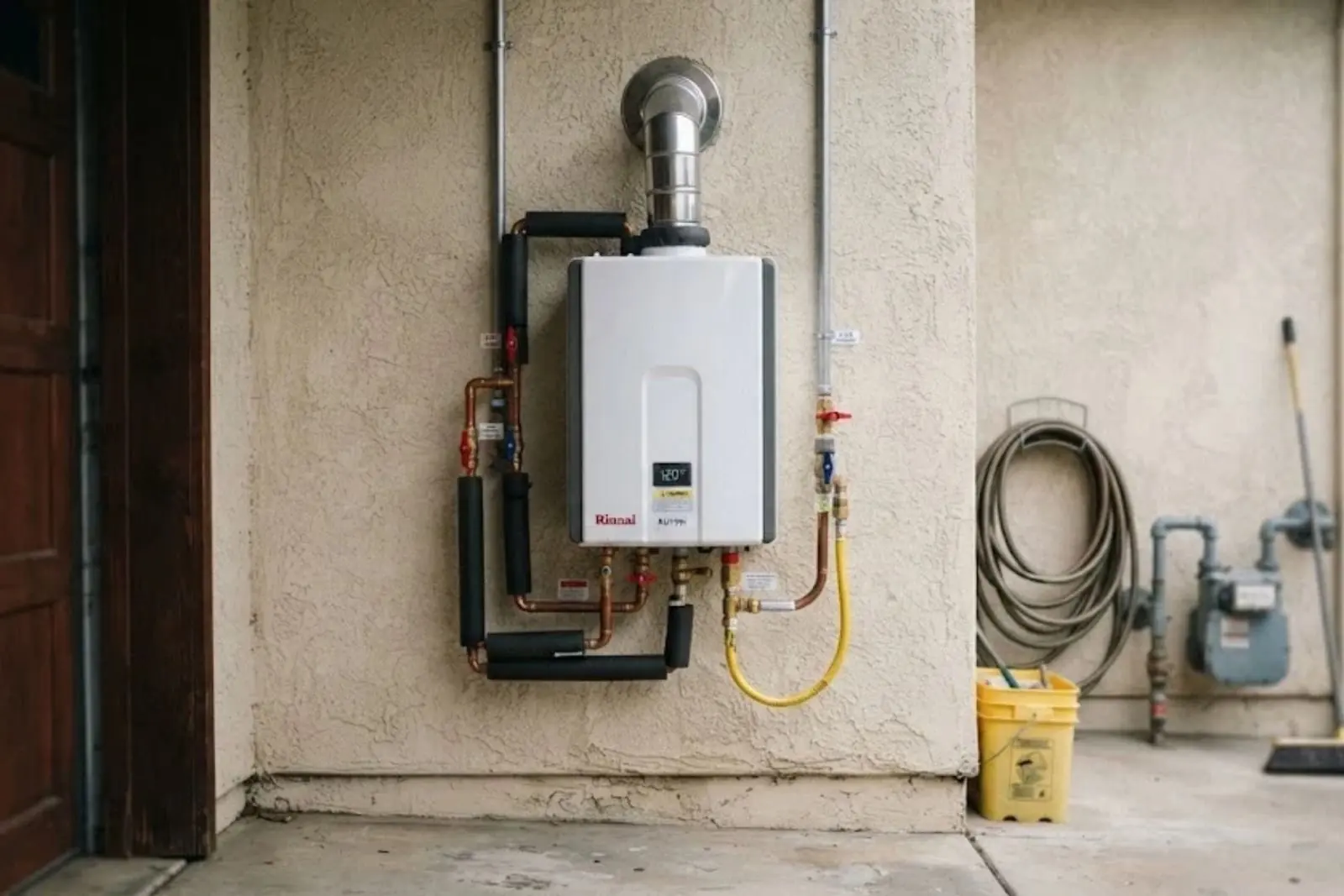
Tankless versus a tank in a Union City home
Where tankless wins
- No standby heat loss from a stored tank
- No large tank to rupture and flood the garage
- Compact wall-mounted footprint
- Steady hot water for long showers or a big tub
Where a tank wins
- Lower install cost on a simple swap
- Works with the existing gas line and flue
- Some standing-pilot gas models still make hot water in a power outage
- Fewer parts that need descaling
Neither is always right. The answer depends on your fixtures, your gas line and how you use hot water.
What a tankless install has to get right
Gas supply sizing
A tankless unit can draw far more gas at once than a tank. The meter, the regulator and the pipe from the meter must carry the combined load. An undersized line causes error codes and cold spots.
Venting
Most tankless units use sealed, stainless or plastic venting that differs from tank flues. Old flues cannot be reused for condensing models.
Condensate
Condensing models make acidic condensate that needs a drain, and often a neutralizer, before it goes to the sewer.
Water supply and isolation valves
Service valves on both sides let a plumber flush the unit. Skip them and the unit cannot be maintained properly.
Descaling a tankless unit on Union City water
The Alameda County Water District reports that Union City receives a blended supply that averages 138 ppm hardness, about 8 grains per gallon, within a 120 to 160 ppm range. A tankless heat exchanger has narrow passages that scale can narrow over time, reducing flow and efficiency.
The practical payoff is a maintenance plan. Flush the unit with a descaling solution on a schedule your manufacturer recommends, and ask whether a scale filter or a water softener belongs in the plan. Your ACWD report gives your neighborhood's number.
A tankless install follows the California Plumbing Code, which is based on the Uniform Plumbing Code (UPC) plus the manufacturer's venting and gas sizing instructions. Ask the installer to show the gas load calculation, because that number decides whether the unit will keep up.
Source type: Alameda County Water District 2025 water quality report
Weighing a tankless upgrade?
Tell us your fixtures and the gas meter size if you know it. We will say what is realistic.
Common tankless problems we fix
Lukewarm output
Scale in the heat exchanger, a flow sensor fault, or insufficient gas supply.
Error code or shutdown
Codes point to ignition, flame, flow, venting or temperature sensor trouble. The manual and a combustion check tell which.
Cold sandwich
Hot, cold, then hot again when a tap is paused briefly. A recirculation setup or buffer tank can soften it.
Leaks
At an isolation valve, a fitting, or the heat exchanger. A leaking exchanger is a larger decision.
Condensate backup
A blocked trap or drain hose causes shutdown on condensing models.
Weak flow
A clogged inlet screen or scale in a narrow passage.
How a descale flush is done
Isolate
Close the gas and water, and open the service valves.
Connect
A pump and hoses run descaling solution through the heat exchanger in a loop.
Circulate
The solution works for the time the maker specifies.
Rinse and restore
We flush with clean water, clean the inlet screen, restore valves and test for flame and flow.
Sizing a tankless unit to your fixtures
A tankless heater is rated by how many gallons per minute it can heat through a given temperature rise. Incoming water here is cool in winter, so the rise is larger and the output drops. A unit that suits a summer shower may not keep up with a shower and a dishwasher in January.
List the fixtures that may run at once and add their flow rates. A plumber can match that total to the unit's rating at your winter rise. If the total is close to the limit, step up a size or plan a second unit for a distant bathroom.
Long pipe runs matter too. Water in the line between the unit and a far tap goes cold, and a tankless heater does not remove that wait. A recirculation loop or a small point-of-use heater near the farthest bath can shorten it.
When tankless does not pay off
If one or two people use modest hot water, a tank may cost less over time once install differences are counted. If your gas line needs upsizing, the job grows. If your water is hard and no one will flush the unit, it can cost more to keep running.
A tankless unit also needs power for its controls, so it does not run in an outage the way some atmospheric tanks do. For a failed tank that needs a quick swap, see replacement. For a new location, see installation.
Tankless water heater questions
Often it does. A tankless unit can draw much more gas at once than a tank, so the meter, regulator and pipe run are checked against the total load.
Follow the manufacturer's schedule. With Union City hardness averaging about 8 grains per gallon, annual flushing is a common starting point.
Usually not. Tankless gas units use venting made for their exhaust, and condensing models need plastic or stainless vent pipe.
To a floor drain or a drain line, often through a neutralizer. We check the route before installation.
Most need electricity for controls and ignition, so they stop when the power does.
Sometimes. The savings and space benefits are smaller in a small household, so the cost difference matters more.