What the Alameda County Water District reports
The Alameda County Water District serves Union City with a blended supply. Hardness runs from 120 to 160 ppm as calcium carbonate, with an average of 138 ppm. ACWD says to divide by 17.1 to get grains per gallon, so the average is about 8 grains per gallon. The district also reports that the disinfectant is chloramines.
The practical payoff is that your decision starts with the number, not a sales pitch. Hardness explains scale. Chloramines explain why a plain filter may not change the taste. ACWD has a hardness map, so check your neighborhood before you buy equipment.
Softener and filter installs follow the California Plumbing Code, which is based on the Uniform Plumbing Code (UPC), including backflow protection and a proper drain connection. Ask the installer how the unit is protected against backflow and where the discharge goes.
Source type: Alameda County Water District 2025 water quality report
What a softener actually does
A salt-regenerated softener swaps calcium and magnesium for sodium or potassium on a resin bed. The resin gets recharged with brine, and the brine flushes to a drain. The result is soft water that protects water heaters, fixtures and glass from scale.
A softener does not make water safer to drink, and it does not remove chloramines. It needs a drain, power, salt refills and a plan for the brine discharge. Ask USD, the sewer agency, whether any local limits apply to softener discharge.
Salt softener versus salt-free conditioner
Salt-based softener
- Removes hardness minerals from the water
- Reduces scale on heaters, fixtures and glass
- Needs salt, power and a drain
- Makes a brine discharge to the sewer
Salt-free conditioner
- Changes how minerals form scale, but does not remove them
- No salt, no brine discharge
- Results vary, especially on the hardest water
- Does not give the slick feel of softened water
Where hardness is about 8 grains per gallon, a true softener is the option that actually lowers hardness. Salt-free units reduce scale in some conditions, but they do not soften.
Choosing between treatments?
Describe the scale, the taste and the fixtures. We will say whether it sounds like hardness or something else.
Which treatment solves which problem
| Treatment | What it addresses | What it does not do |
|---|---|---|
| Salt softener | Hardness and scale | Chloramines, taste, sediment |
| Whole-house carbon | Chlorine taste and odor, some organics. Chloramine reduction needs catalytic carbon and enough contact time | Hardness |
| Under-sink RO | Dissolved solids at one tap, better drinking water taste | Whole-house scale, high flow |
| Sediment filter | Particles and grit | Dissolved minerals, taste |
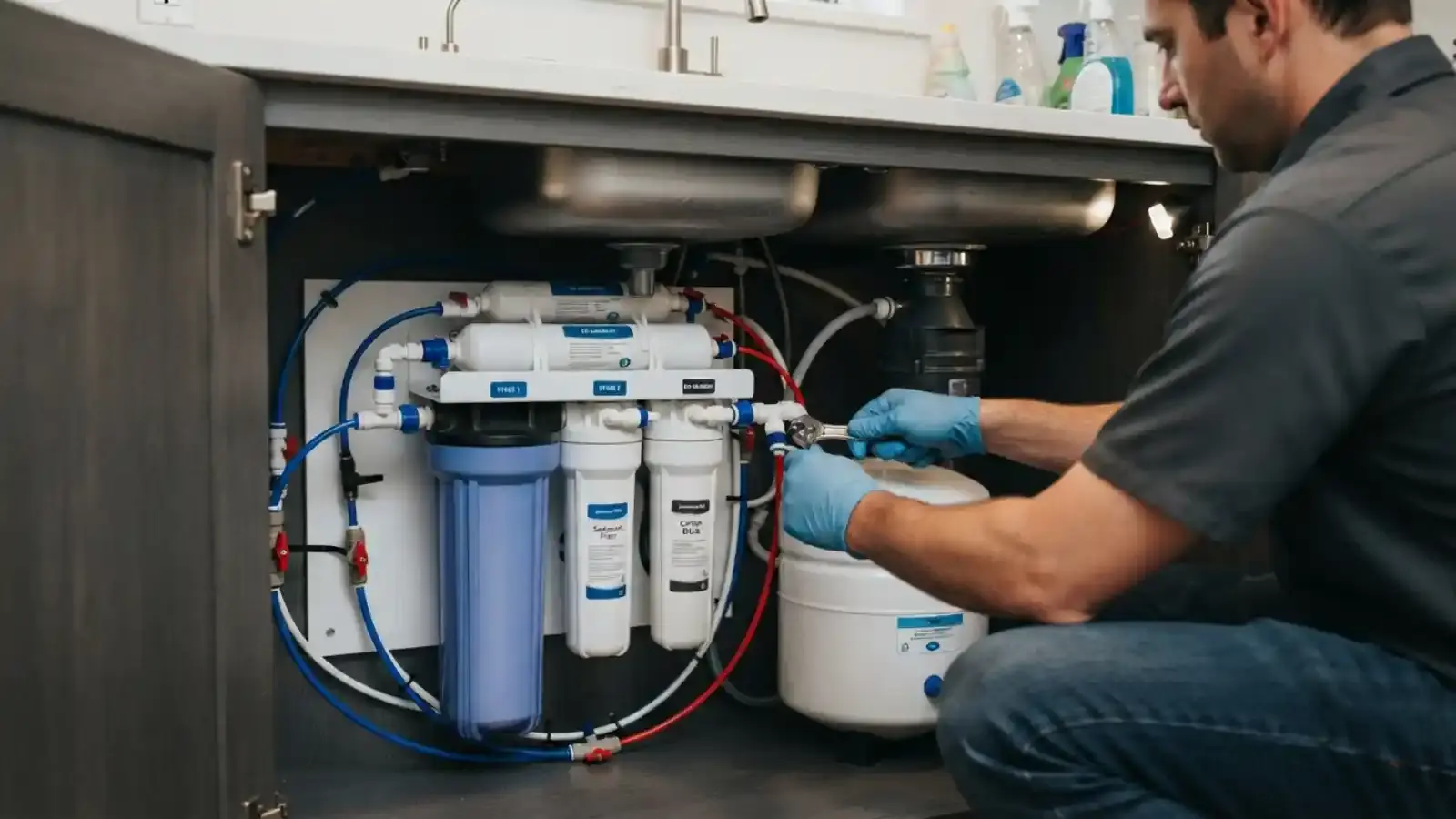
RO systems waste some water to drain and need a storage tank and a drain saddle. They treat drinking water at one tap, not the whole house.
What filtration cannot do
No filter or softener replaces the testing and treatment done by the water district. We make no health claims beyond what the ACWD report says. If you have a specific concern, such as a medical need or an unusual taste, get your tap water tested by a state-certified lab.
A softener will not fix low pressure, a rusty pipe or a leaking fixture. For those, see leak detection or repiping.
How to test your tap first
- Read the ACWD report. Find your area's hardness on the district's map or report.
- Use a test strip for a quick check. Hardness strips cost little and show whether scale matches the number.
- Look at the symptoms. White crust on fixtures points to hardness. A chlorine smell points to disinfectant. Cloudiness points to air or particles.
- Decide what you want. Scale protection, better drinking taste, or both.
- Ask about maintenance. Salt refills, filter changes and RO membranes all have schedules.
How a softener is plumbed in
Pick the location
Near the main shutoff with a drain and power nearby. A bypass valve is part of the plan.
Plumb the loop
Hot and cold supply lines are arranged so outdoor hose bibs and the kitchen cold tap can be left unsoftened if you choose.
Run the drain
The brine line needs an air gap and a proper discharge point.
Program and test
Hardness, capacity and regeneration schedule are set, and the system is tested for leaks.
A softener extends the life of a tankless unit and tank heaters, though it does not replace flushing. Our crew also serves Fremont, see plumbing in Fremont.
Softener and filtration questions
The Alameda County Water District reports a blended supply with hardness of 120 to 160 ppm, averaging 138 ppm, or about 8 grains per gallon. Your own neighborhood may differ, so check the district's hardness map.
No. A softener treats hardness. ACWD uses chloramines as its disinfectant, and reducing them takes catalytic carbon with enough contact time.
They do different things. A salt softener removes hardness. A salt-free conditioner changes how scale forms and does not soften the water.
Whole-house carbon treats taste and odor at every tap. RO treats drinking water at one tap and wastes some water to drain. Many homes use one or both for different goals.
It reduces scale in the tank and on elements, though you should still check the anode rod and flush occasionally.
We make no health claims beyond what the ACWD report states. A softener treats hardness only.