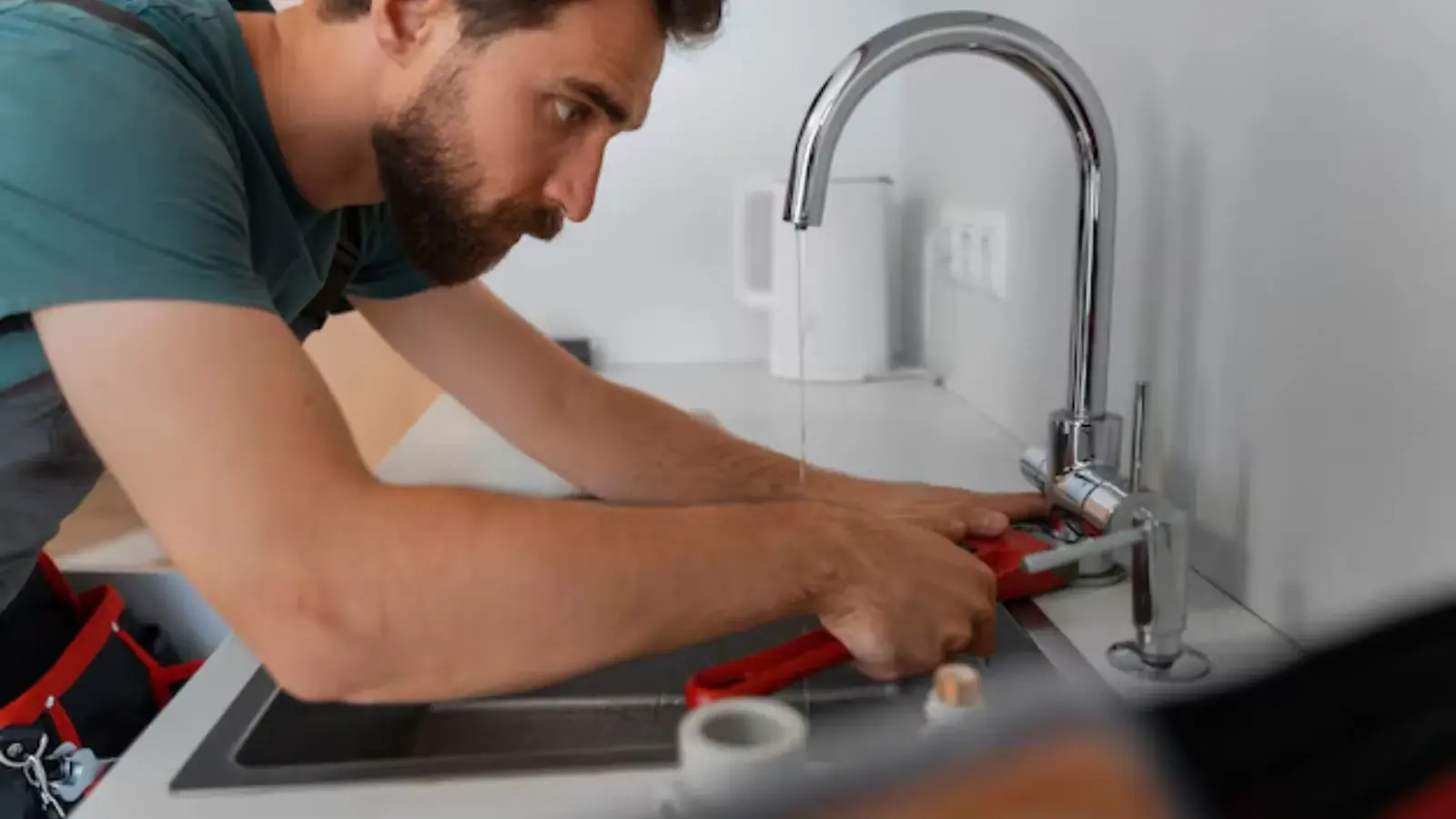
A faucet that will not shut off at 2 a.m.
Faucets fail at awkward hours because they run all day and nobody notices until the house is quiet. A stream that continues with the handle off means the cartridge or valve seat inside is worn through. A stream that blasts from the base or the supply line means a hose or fitting has failed.
Start under the sink. Each faucet should have its own quarter-turn or multi-turn stop valve on the hot and cold lines, and turning them off will stop most spraying. If the valve does not hold, or the faucet is on a laundry sink or a hose bib, shut off the main house valve and call.
Do not keep cranking the handle to stop a drip. That grinds the seat and turns a small repair into a valve replacement.
Cartridge, ball, disc or washer: how the faucet is built
Four designs cover most faucets in Union City homes. Knowing which you own tells you what the fix really involves.
Cartridge faucets
Single-lever kitchen and bath faucets use a plug-in cartridge. When the lever feels gritty or the water cannot be shut off, a new cartridge restores a smooth stop. Parts must match the brand and model.
Ball faucets
Found on many older kitchen faucets, with a rotating ball and rubber seats. Drips from the spout or leaks around the handle usually mean worn seats and springs, which come in a service kit.
Ceramic disc faucets
Two polished discs slide against each other, and they are long-lived. When one drips, scale or sediment on the discs is the usual culprit, so the cartridge is cleaned or swapped.
Compression faucets
Two handles, each with a rubber washer pressing on a seat. They drip when the washer hardens or the seat pits. A pitted seat can be resurfaced or the stem replaced.
What Union City water does to faucets
ACWD reports that the blended supply reaching Union City runs 120 to 160 ppm hardness (average 138, about 8 grains per gallon), and it is treated with chloramines. Hard water leaves scale on aerators and disc faces, and chloramines are commonly blamed for stiffening rubber washers and seals over the years.
That is why a faucet that slowly loses flow often needs its aerator soaked in vinegar and its cartridge cleaned, not replaced. If you are shopping for a new faucet, note that the 2025 California code limits kitchen faucets to 1.8 gpm and bathroom faucets to 1.2 gpm, so a new bath faucet may feel softer than the old one.
Source type: Alameda County Water District water quality report and 2025 California Green Building Standards Code
Kitchen, bathroom and outdoor faucets compared
| Faucet | Typical trouble | What we usually do |
|---|---|---|
| Kitchen | Pull-down hose leaks, spray head clogs, dripping spout | Replace hose or cartridge, descale the aerator, check the supply lines |
| Bathroom | Slow flow, dripping at the spout, wobbly handle | Clean the aerator, service the cartridge or seats, tighten the mount |
| Outdoor hose bib | Leak at the handle, drip at the spout, leak behind the wall | Replace the packing or washer, or the whole valve, and check the vacuum breaker |
A hose bib that leaks inside the wall when you run water is a repair we want to see sooner, not later.
Water on the cabinet floor?
Shut the stop valves, empty the cabinet and call. We will tell you what is safe to leave until morning and what is not.
Sink drains and traps: why the water will not leave
Many faucet calls turn out to be drain calls. A sink that fills and drains slowly is rarely the faucet's fault.
Check the stopper and strainer
Bathroom pop-up stoppers collect hair, and kitchen strainer baskets collect scraps. Removing and cleaning them solves a surprising share of slow sinks.
Open the P-trap
The curved pipe under the sink holds a water seal against sewer gas and catches debris. We loosen the slip nuts over a bucket, clear it, and reseat the washers.
Snake the branch drain
If the trap is clean and the sink still crawls, the blockage is in the wall pipe. A small drain machine reaches it without damaging the fixture.
Replace worn parts
Brittle trap arms, corroded tailpieces and leaking washers get swapped for new fittings.
If every sink in the house is slow, jump to sewer line cleaning because the blockage is farther down the line.
What decides the bill for a faucet repair
Repair the faucet or buy a new one
Repair when
- The body is sound with no pitting or cracks
- A cartridge or washer kit is readily available
- The finish is in good shape
- The leak is at a stem, hose or supply line
Replace when
- The body is corroded or the finish is peeling
- Parts are discontinued or the faucet is a decades-old design
- The faucet has been repaired several times already
- You want a lower-flow or touchless model
Outside the house, a water line repair may be the real answer if the leak is on the supply side of the hose bib.
Faucet questions answered
Yes. The line is answered 24/7, including nights, weekends and holidays. A faucet that will not shut off or a supply line spraying water is treated as an emergency, and we will tell you how to hold things steady.
The cartridge, ball seat or washer is worn, or mineral scale has roughened the sealing surface. Replacing the working part usually restores the shutoff. If the valve body is damaged, a new faucet is the better choice.
Yes, and we recommend it when they are old, stiff or crusted. A new quarter-turn valve gives you a reliable way to isolate that faucet for the next repair. The main shutoff has to be closed during the swap.
Scale in the aerator or a kinked pull-down hose is the common cause. Remove the aerator, soak it in vinegar, and flush the line. If flow stays weak, check the supply lines and the cartridge.
A drip at the spout can wait. Water leaking inside the wall or running steadily from the packing nut is worth a call, because it can soak framing and siding.
Yes. We clean the stopper, open the trap and snake the branch line if needed.