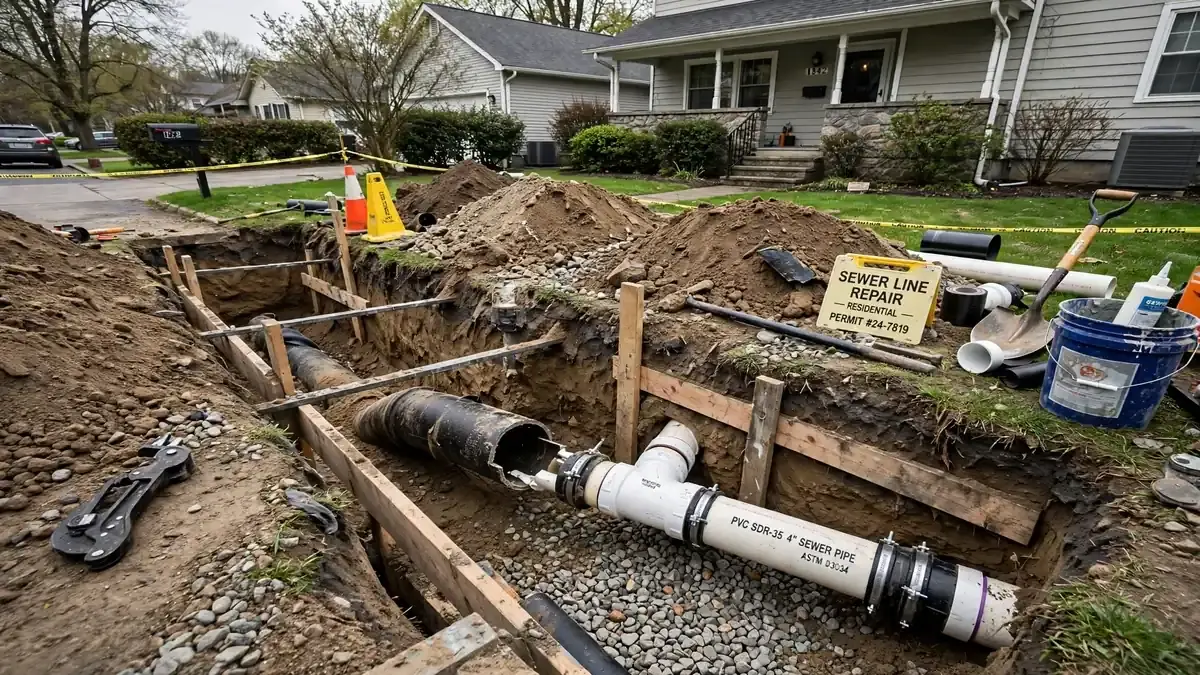
Signs a Sewer Line May Be Leaking
A sewer lateral is buried, so you rarely see the leak. You see what it does around the yard and the house.
Wet or lush patch
A soggy spot or unusually green strip over the lateral route, even in dry weather, can mean wastewater is escaping.
Sewer smell outside
A foul odor near the foundation or cleanout that comes and goes is a classic sign.
Slow drains everywhere
Several fixtures draining slowly together points to the main line, not a single trap.
Sunken ground
A dip in the lawn or driveway can mean the soil is washing away into a cracked pipe.
Gurgling and backups
Toilets gurgling when the washer runs, or water rising in the lowest drain, suggest a restriction or break.
Recurring roots
If you keep needing the line cleared, roots may have entered through a joint, which is a leak in itself.
None of these confirms a leak alone. A sewer camera inspection is how a plumber sees the pipe and the break.
Whose Pipe Is It in Union City?
Union Sanitary District serves sewer for Union City, Fremont and Newark. USD says each property owner is responsible for the entire sewer from the house to where it connects to the main, including the part under the sidewalk and street. That means a lateral leak is your repair, even when it sits beneath public ground.
If a backup starts, call USD's 24 hour line at (510) 477-7500. USD checks its public main for free, and if the main is clear, the blockage is probably in your lateral. That check tells you whether your next call goes to a plumber.
USD requires a repair permit before any lateral work, even on private property. Digging in the street also needs a city encroachment permit, and you must call 811 at least two working days before digging. A plumber who skips these steps is putting you at risk.
A sewer lateral repair follows the California Plumbing Code, which is based on the Uniform Plumbing Code (UPC) for pipe type, slope and joints, and the Union Sanitary District adds its own permit and inspection step. Ask who pulls the permit and who schedules the inspection before any digging starts.
Source type: Union Sanitary District
Open Trench or Trenchless Lining
Open trench repair
- Replaces the damaged section with new pipe
- Best when the pipe has collapsed or has a belly
- Needs excavation, so yards and driveways are disturbed
- Lets the plumber correct slope as well
Trenchless lining
- Lines the inside of the existing pipe, with little digging
- Best for cracks, joints and root entry in intact pipe
- Cannot fix a collapsed or badly misaligned section
- Access points are still needed at both ends
The right choice depends on what the camera shows. If a plumber recommends a method without inspecting the pipe, ask why.
What to Do in the First Day
Stop adding water
Skip laundry, long showers and the dishwasher until the line is cleared. Every gallon you add has nowhere to go.
Check the cleanout
If you have a cleanout cap outdoors, look for standing water or smell, but do not open a cap on a backed-up line, because it can overflow. Older homes may lack one, which matters for the repair plan.
Call USD for the main
Ask USD to check the public main. Do not open manholes, which only USD personnel are authorized to do.
Get a camera inspection
A camera shows the break, its depth and the pipe material, which decides the repair and the permit path.
Sewer smell or backup right now?
Stop using water and call. A plumber on the 24/7 line can help you sort out what to check first.
Match the Repair to the Pipe
| What the camera shows | Usual direction | Ask your plumber |
|---|---|---|
| Root entry at joints | Cut roots, then line or replace the section | What stops the roots from returning? |
| Cracked but round pipe | Spot repair or full lining | Is the lined pipe still the right diameter? |
| Collapsed or offset pipe | Open trench replacement | How far will the trench run, and what is restored? |
| Bellied section holding water | Replace and re-slope the section | Can I see the camera footage? |
| Older cast iron with heavy corrosion | Replace, since lining depends on the host pipe | Is the whole run bad or just one spot? |
Before You Authorize Anything
Ask for the camera footage, the break location in feet from the cleanout and the permit plan in writing. A plumber who has seen the pipe can show you the same video, and that makes a second opinion easy. Our sewer line repair page explains how we approach the work, and our sewer inspection page covers the camera step. We also take these calls from Fremont, which shares the same USD rules.
Sewer Leak Questions
A clog shows up as slow or backed-up drains. A leak shows up outside as wet ground, odor or sinking soil, though the two often occur together. A camera inspection tells them apart.
Not on your property. In Union City, USD says the owner is responsible for the lateral from the house to the main.
Sometimes, with trenchless lining, if the pipe is intact enough to line. A collapsed or offset pipe usually needs excavation.
USD requires a repair permit before any lateral work, even on private property. Digging in the street also needs a city encroachment permit.
Call USD's 24 hour line at (510) 477-7500. They check the public main for free. If it is clear, the blockage is probably in your lateral and a plumber should look at it.
Trenchless lining and spot repairs can limit digging. Open trench work disturbs the yard along the pipe route, and a plumber should explain what is restored before the work starts.
Roots enter through joints and small cracks seeking water, then grow and widen the opening. Clearing roots without fixing the entry point means they come back.