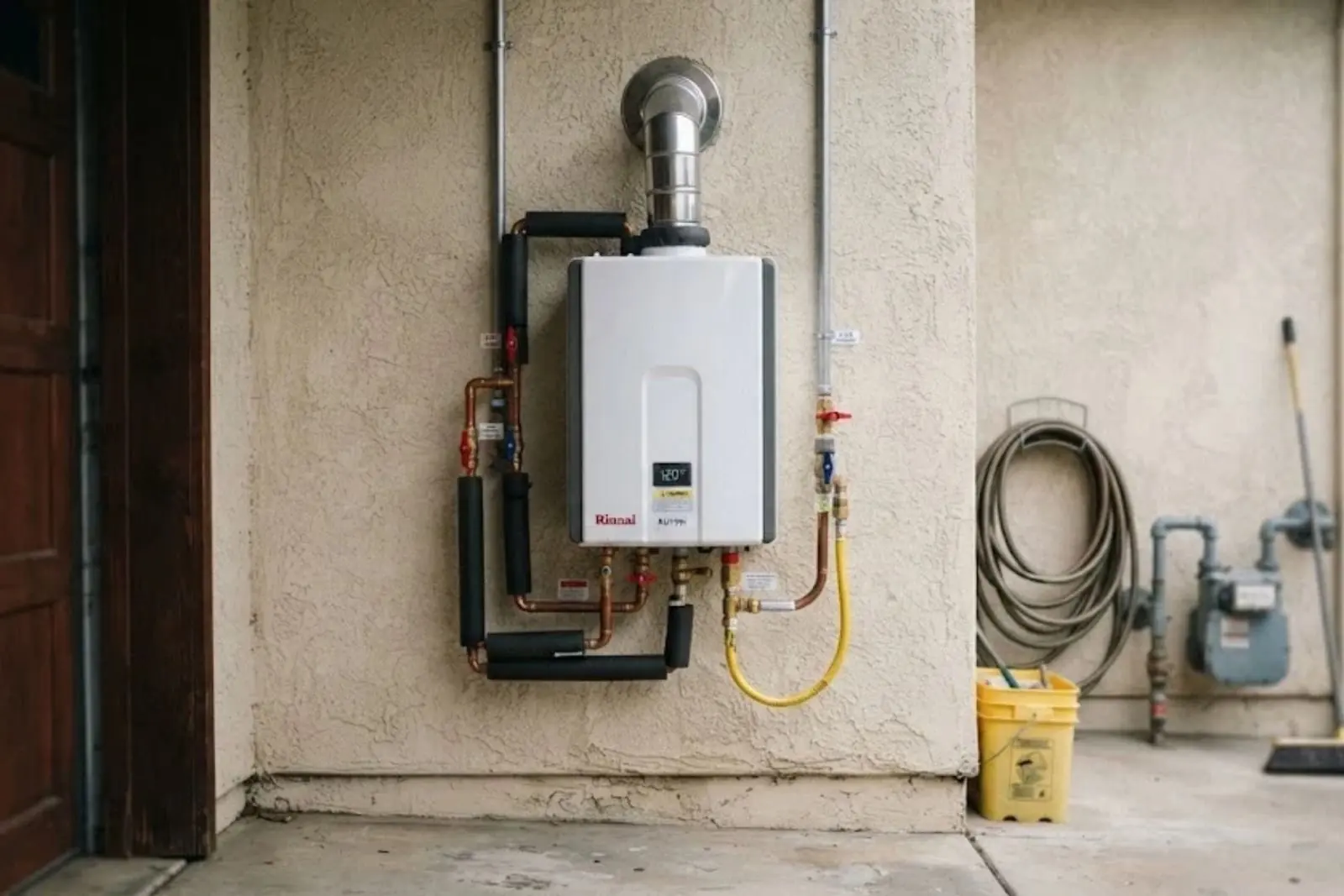
The Short Answer
A tankless heater can be a good replacement when you have the gas capacity, a workable vent route and a plan for scale. It is a poor one when the gas line is undersized, the vent run is awkward or you rarely use much hot water. Most of the cost and trouble sits in the house around the heater, not in the heater itself.
If you want the product details first, our tankless water heater page covers installation. This post is the decision guide.
Tank and Tankless, Side by Side
Where a tank wins
- Simple swap with existing gas line, flue and location
- Handles several fixtures at once without a flow limit
- Lower upfront parts and labor in most homes
- Easier for any plumber to service
- Forgiving of poor maintenance for longer
Where tankless wins
- No standby heat loss from a stored tank
- Endless hot water for a single long shower
- Frees floor space in a closet or garage
- Often lasts longer when descaled on schedule
- No tank to fail and flood a room
Notice the trade. Tankless saves energy and space, but it asks more of the gas line, the vent and your maintenance habits.
A Four-Step Check Before You Commit
Count your peak demand
List what runs at once on a normal morning, such as a shower, a dishwasher and a washer. Every tankless unit has a maximum flow rate at a given temperature rise, and simultaneous use can exceed it.
Look at the gas supply
Tankless burners draw far more gas at once than a tank burner. The meter, regulator and pipe size must support it, and upsizing a gas line is often the biggest add-on in the whole job.
Trace the vent route
Condensing models vent with plastic pipe and drain acidic condensate. Non-condensing models need stainless vent. Either way you need a clear path to the outside and a place for the condensate to go.
Plan for the next ten years
Decide who will flush the heat exchanger and when. A tankless unit without descaling is a slow failure waiting to happen.
Union City Water and Why It Matters Here
The Alameda County Water District reports Union City's blended supply at 120 to 160 ppm hardness, averaging 138 ppm, or about 8 grains per gallon. Scale forms inside a tankless heat exchanger the same way it forms in a kettle, and narrow passages clog sooner than a tank floor. Ask for isolation valves at install so descaling is a short job, and ask whether a softener belongs in the plan.
A practical routine is simple. Close the isolation valves, circulate a descaling solution through the unit with a small pump, rinse, and reopen. Done on a schedule it is a short job, and it keeps the unit from running hot and shutting down on error codes.
ACWD's disinfectant is chloramines. That does not change the heater choice, but it is a reason to read your own ACWD water quality report rather than assume what your neighborhood gets.
A tankless install is built to the California Plumbing Code, which is based on the Uniform Plumbing Code (UPC), together with the manufacturer's venting and gas sizing instructions. Ask each contractor how they will size the gas line and vent, since an undersized line is the most common way a tankless unit underperforms.
Source type: ACWD water quality report
What the Conversion Changes in the House
Gas line
May need a larger pipe run from the meter to the heater, with a pressure test afterward.
Venting
A new direct vent to the outside, sometimes through a wall instead of the old roof flue.
Water side
Isolation valves, a pressure relief arrangement and often a recirculation plan for faster hot water.
Power and drain
A nearby outlet for the controls and a condensate line on condensing models.
Ask your plumber to list each of those four items in writing. Tankless quotes that skip them are quoting a different job.
Not sure your house can take a tankless?
Tell us where the heater sits and where the gas meter is. A plumber can usually tell you quickly what the swap involves.
When Staying With a Tank Makes Sense
A tank is the sensible pick when your household is small, your vent is hard to reroute or your old tank is simply failing and you want it replaced today. Our water heater replacement service covers the like-for-like path. It is faster and cheaper, and nobody should feel pressured to upgrade.
A tankless unit makes more sense when you are remodeling anyway, the heater will move, or you want the floor space back. It also suits a household that uses hot water in long, steady stretches rather than many short bursts at once.
Whatever you choose, get the scope in writing. A fair quote names the gas pipe size, the vent type, the condensate plan and the descaling valves. We also take these questions from Fremont homeowners, where the same ACWD water raises the same scale questions.
Tankless Conversion Questions
Sometimes. The footprint is smaller, but the gas pipe, vent and condensate drain still have to reach it. A plumber needs to see the space.
They run as long as the flow stays within the unit's rating. Run too many fixtures at once and the water temperature drops.
A short burst of cold water that appears between two hot draws, because the unit shuts off and restarts. Recirculation and correct sizing reduce it.
Not without backup power. The controls, fan and ignition need electricity, so a gas tankless heater stops when the power does.
Yes. The heat exchanger needs a periodic descaling flush, more so with moderately hard water.
ACWD reports an average hardness of 138 ppm for the blended supply, about 8 grains per gallon. That is enough to scale a heat exchanger over time, so plan on isolation valves and scheduled descaling, and ask about a softener.
Often the savings are modest. If you rarely use much hot water and the swap needs gas and vent upgrades, a high-efficiency tank can be the better value.