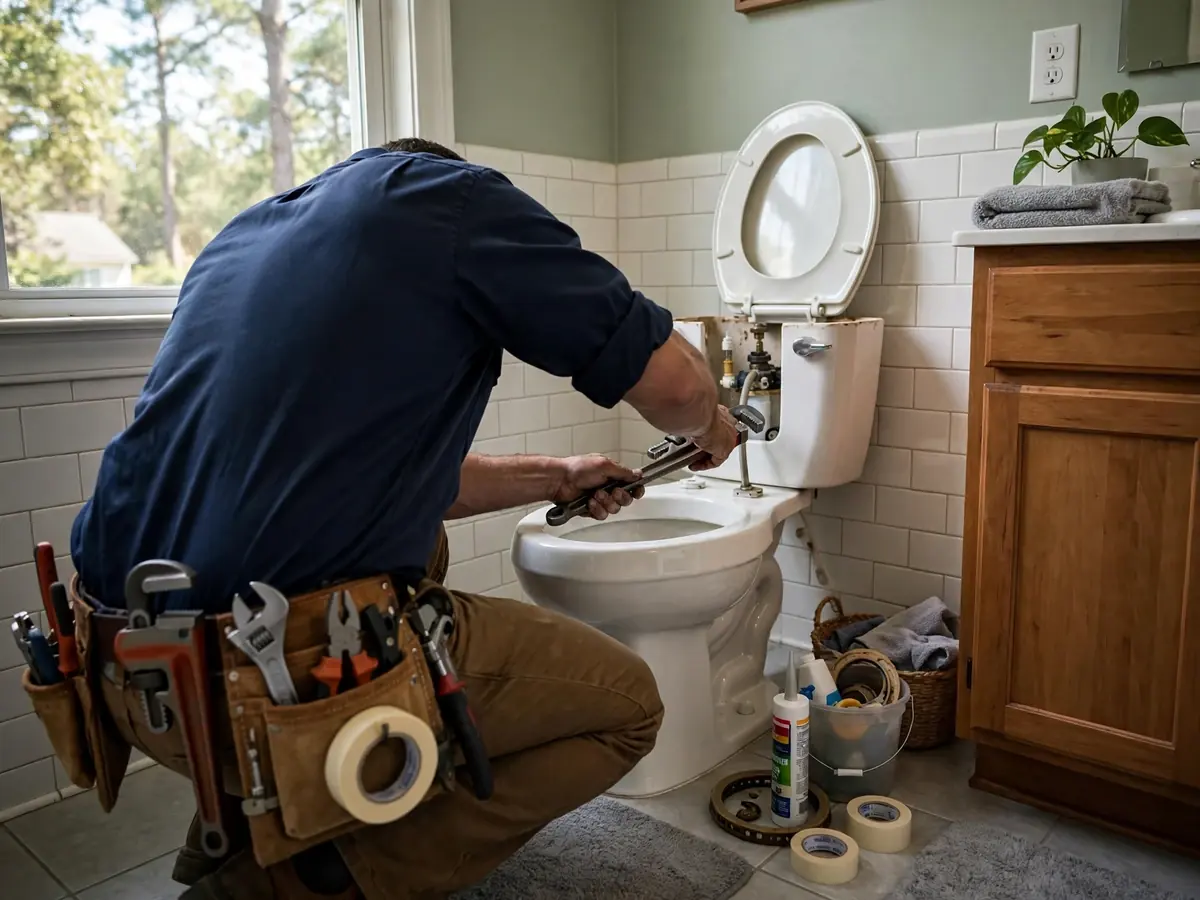
How a Toilet Swap Goes, Start to Finish
A toilet swap is one of the most common jobs a homeowner considers doing alone. The work is not hard. The trouble is in what the old toilet was hiding, and in picking a bowl that does not fit.
Here is the sequence a plumber follows, so you know what to expect whether you do it or hire it out.
Shut off and drain
Close the stop valve on the wall, flush, and sponge out the remaining water in the tank and bowl. Disconnect the supply line.
Lift the old toilet
Remove the nuts at the base and rock the bowl free from the wax ring. Cover the open drain right away, because sewer gas and dropped tools both find their way in.
Inspect the flange
The flange is the ring on the floor that holds the closet bolts. Check for cracks, corrosion and whether it sits flush on the finished floor. A weak flange is the most common surprise.
Set the new bowl
Fit a new wax ring or approved seal, lower the bowl straight down onto the bolts and press it into place. Tighten the nuts a little at a time on alternating sides so the porcelain does not crack.
Connect and test
Attach a new supply line, open the stop valve slowly, flush several times and run a dry paper towel around every joint. Any dampness means stop and fix it now.
California Rules That Affect Your Choice
The 2025 CALGreen residential standards, effective January 1, 2026, cap new toilets at 1.28 gallons per flush. Union City adopted the 2025 California codes, so any new model you buy should say 1.28 gpf or lower on the box. If it does not, do not install it.
ACWD's rebate page lists toilet rebates for commercial and multifamily customers, not for single-family homes. Check the page before assuming a rebate applies to your house.
A like-for-like swap is routine, but moving a toilet or replacing concealed drain pipe is new work. Union City's documents say that needs a permit and inspection, so call the Building Division at 510.675.5313 before you open walls.
Source type: 2025 CALGreen (HCD), ACWD rebate page, City of Union City permit guidance
Pick the Right Toilet for Your Bathroom
Three measurements and two preferences decide almost every purchase.
| Check | How to measure | Why it matters |
|---|---|---|
| Rough-in | Wall to the center of the flange bolts, using the finished wall | Twelve inches is common, but ten and fourteen exist and will not fit a mismatched bowl |
| Bowl shape | Round or elongated | Elongated is more comfortable but longer, so check clearance to the door and vanity |
| Height | Standard or comfort height | Pick what suits the people who use it |
| Style | One-piece or two-piece | One-piece is easier to clean, two-piece is easier to carry upstairs |
| Supply and flange | Stop valve location and condition | Old valves that will not close are replaced during the swap |
Problems a Toilet Swap Can Uncover
Replacing a toilet lets you see what the old one was hiding. These are the usual finds.
Rotted subfloor
A slow leak at the base softens the floor. Soft wood around the flange needs repair before a new toilet goes on.
Damaged flange
A cracked or low flange cannot hold the bowl steady, which leads to rocking and a failed seal.
Seized stop valve
Old shutoffs that will not close or drip when touched should be replaced, not reused.
Drain trouble
A drain that gurgles or backs up after the swap points to a clog or vent issue in the line itself.
Floor feels soft around the base?
Stop using the toilet and call. A plumber can check the flange and tell you whether the floor needs work first.
Before You Buy or Book
- Measure the rough-in from the finished wall to the bolts, not to the baseboard.
- Confirm the bowl is rated 1.28 gallons per flush or less.
- Check clearance in front of the bowl and beside the sink or tub.
- Look at the shutoff valve and replace it if it does not turn smoothly.
- Ask whether the quote includes a new wax ring, bolts and supply line.
- Ask how old toilet disposal is handled.
If the toilet keeps clogging or running, repair may be better than replacement. Our toilet repair and installation page covers that decision, and our plumbing installation service handles moves and new bathrooms.
A Quick Note on DIY
A confident homeowner can swap a toilet in an afternoon. The risk is a hidden flange or floor problem, which you find only after the old bowl is up.
If you plan to do it yourself, buy the wax ring, bolts and supply line before you start, and keep the old toilet in place until the new one is on the shelf. A bathroom with no working toilet makes for a long evening. If you want help on the hard part, we also take calls from Fremont and the surrounding area.
New Toilet Questions
Measure from the finished wall behind the toilet to the center of the closet bolts. Twelve inches is the most common, but check yours.
Yes, in most cases. They cost little compared with the toilet, and a seized or weeping valve is the most common cause of a leak right after a swap.
Yes. A used wax ring will not reseal reliably. Always fit a new one or an approved alternative.
Usually an uneven floor or a flange that sits too low or high. Do not overtighten the bolts, because porcelain cracks. Shim or reset the flange instead.
One-piece is easier to clean and has fewer seams. Two-piece is easier to carry and replace in parts. Performance depends more on the model than the style.
The 2025 CALGreen standards cap residential toilets at 1.28 gallons per flush, and Union City adopted the 2025 California codes effective January 1, 2026. Check the label before you buy.