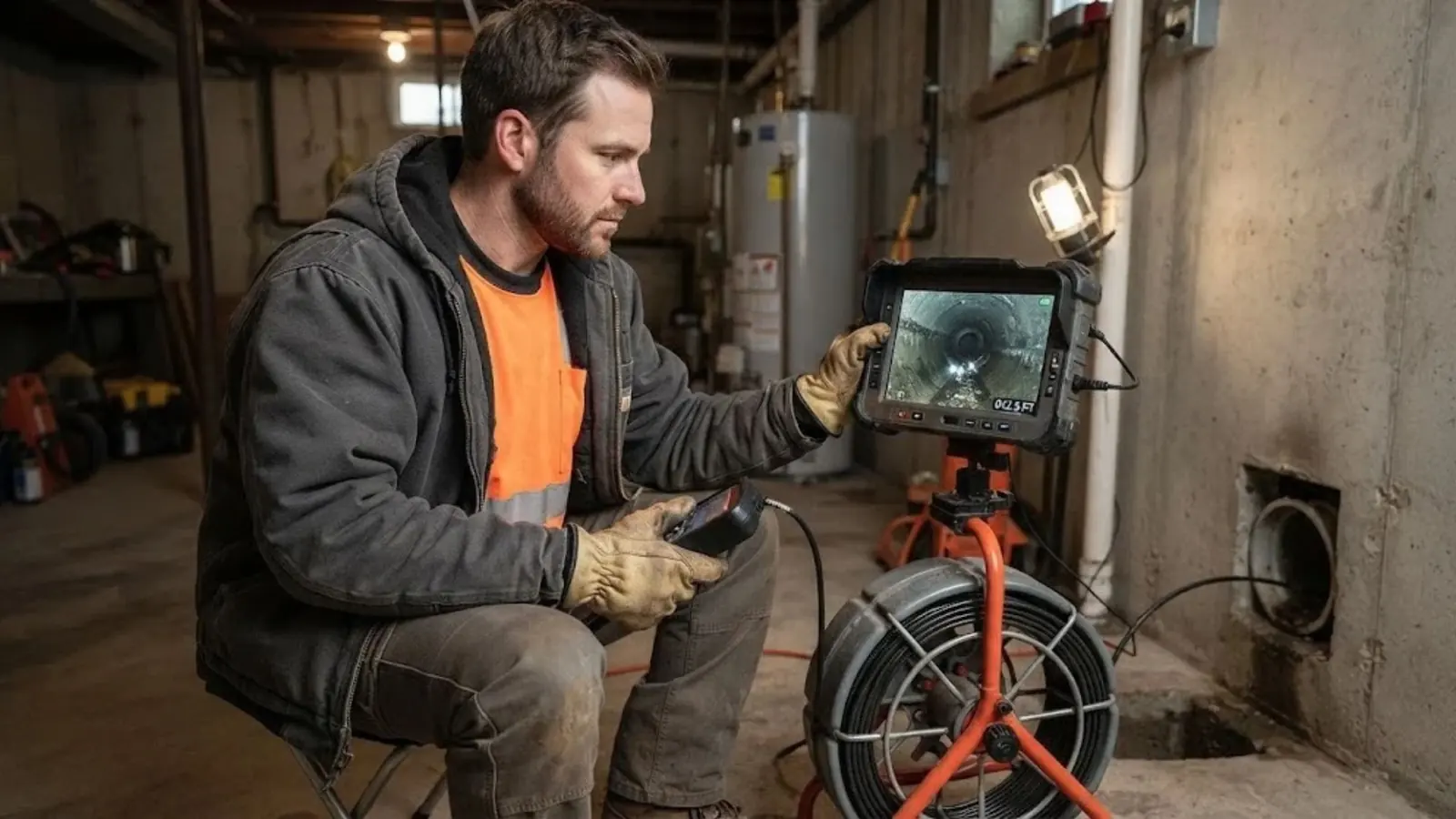
What a useful report contains
A good report is more than a video. Look for each of these before you rely on it.
Address, date and start point
The report should say where the camera went in, such as a cleanout or a fixture.
Pipe material and size
Cast iron, clay, plastic and bituminized fiber behave differently and fail differently.
A distance counter
Feet from the entry point are shown on the footage and used to log each defect.
A defect log
Each finding should list distance, position on the pipe and a short description.
Photos or stills
Stills of the worst points make it easier to compare against a second opinion.
The conclusion and its basis
A recommendation should point to specific footage, not just a general statement.
Defect vocabulary in plain terms
| Term | What you see | What it usually means |
|---|---|---|
| Root intrusion | Fine roots growing into a joint or crack | The joint is open. Roots return unless the pipe is repaired or lined |
| Offset or displaced joint | Pipe ends do not line up | A lip catches debris and the gap can worsen |
| Crack | A line along or around the pipe | Lengthwise cracks are generally more serious than hairline ones |
| Fracture or break | Pieces visible, pipe wall missing | Structural failure and a repair candidate |
| Belly or sag | Standing water in a low spot | Debris collects there and may need repair if the dip is deep |
| Scale or tuberculation | Crusty buildup inside cast iron | Narrowed pipe and rougher flow |
| Deformation | An oval or flattened pipe | Often seen in bituminized fiber pipe and a sign of weakness |
| Infiltration | Water entering at a joint or crack | The pipe is no longer sealed |
| Obstruction | The camera cannot pass | Something blocks the line, or the pipe has collapsed |
Walk the footage in four passes
Check the header
Confirm the address, date, start point and that the distance counter starts at zero.
Follow the counter to the main
Does the footage reach the connection to the main, or stop short? A stopped inspection is an incomplete answer.
Match each defect to the log
Pause at each logged distance and see whether the footage supports the description.
Compare the summary to what you saw
If the summary calls the pipe failing and the footage shows a few light scale marks, ask why.
Ask whether the line was cleaned before the camera went in, and see sewer line repair for the options once you know what the defects are. Heavy grease or debris can hide defects, and a pre-cleaned pipe shows more.
Monitor or act
Often fine to monitor
- Light scale on cast iron with good flow
- Isolated grease or debris that clears with cleaning
- A single hairline crack with no roots or soil
- A shallow sag with no standing water
Usually worth acting on
- Roots at several joints
- A fracture, collapse or missing pipe wall
- A deep belly that holds water
- Displaced joints with soil visible
- An obstruction the camera cannot pass
Notes alone do not decide. The footage, the pipe material and the age of the house all go into the call.
What the footage needs to do for Union Sanitary District
In Union City, the owner owns the whole lateral to USD's main. USD allows an old capped lateral to be reused only if it is connected, in good condition, has video submitted and meets current standards. If you plan to reuse a lateral on a rebuild, ask the inspector to give you a complete recording you can hand over.
USD also requires a repair permit before any lateral work, and it asks you to notify your USD inspector 48 hours before an inspection. Ask the contractor to keep the camera file and stills in a form you can share with USD or a second inspector.
Source type: Union Sanitary District FAQ and repairs page
Getting a better report in the first place
Ask the inspector to clean the line first if it is slow or backing up, since debris hides defects. Ask for the full recording, not only clips, and for the distance counter to stay on screen.
Tell the inspector the house age, any past backups and any cleanout you know about. That context helps the operator read what the camera sees, and it gives you a record to compare with later.
Report in hand and a decision to make?
Call and read us the defect log. A plumber can tell you what the terms mean and what to ask the seller or contractor.
When to get a second opinion
- The report calls for full replacement but the footage shows a single defect
- The summary and the footage do not match
- There is no distance counter or the inspection stopped before the main
- You were not given a copy of the video
- The only option offered is the most expensive one, with no spot repair or lining comparison
- The inspector is also the only one pitching the repair and a deadline is pushed
- You are buying a house and the repair estimate would change your offer
What a camera cannot tell you
A camera shows the inside of the pipe. It does not show soil conditions, how the pipe was bedded or whether a stoppage will come back next week. It also sees only what the operator points it at, so a short run can miss a defect further down.
Treat the report as strong evidence, not a verdict. Pair it with the pipe age, the house history and what the drains actually do.
Reading a sewer camera report
In Union City, you own the entire lateral from the house to USD's main, including under the sidewalk and street. The main itself belongs to USD.
A belly is a low spot where the pipe has sagged and holds water. Small bellies can be monitored. A deep one tends to collect debris and may need repair.
Not automatically. Roots at one joint can be cut and watched. Roots at many joints mean the pipe is open at several points and the fix is usually repair or lining.
Yes if the recommendation is large and the footage does not obviously support it, or if you did not receive the video. A second look costs far less than a repair you did not need.
For reusing an old capped lateral, USD requires video that shows the pipe is in good condition and meets current standards. Keep a full copy of the recording from any inspection.
Yes. USD also serves Fremont, so the same ownership and video rules apply. See our Fremont plumbing page.