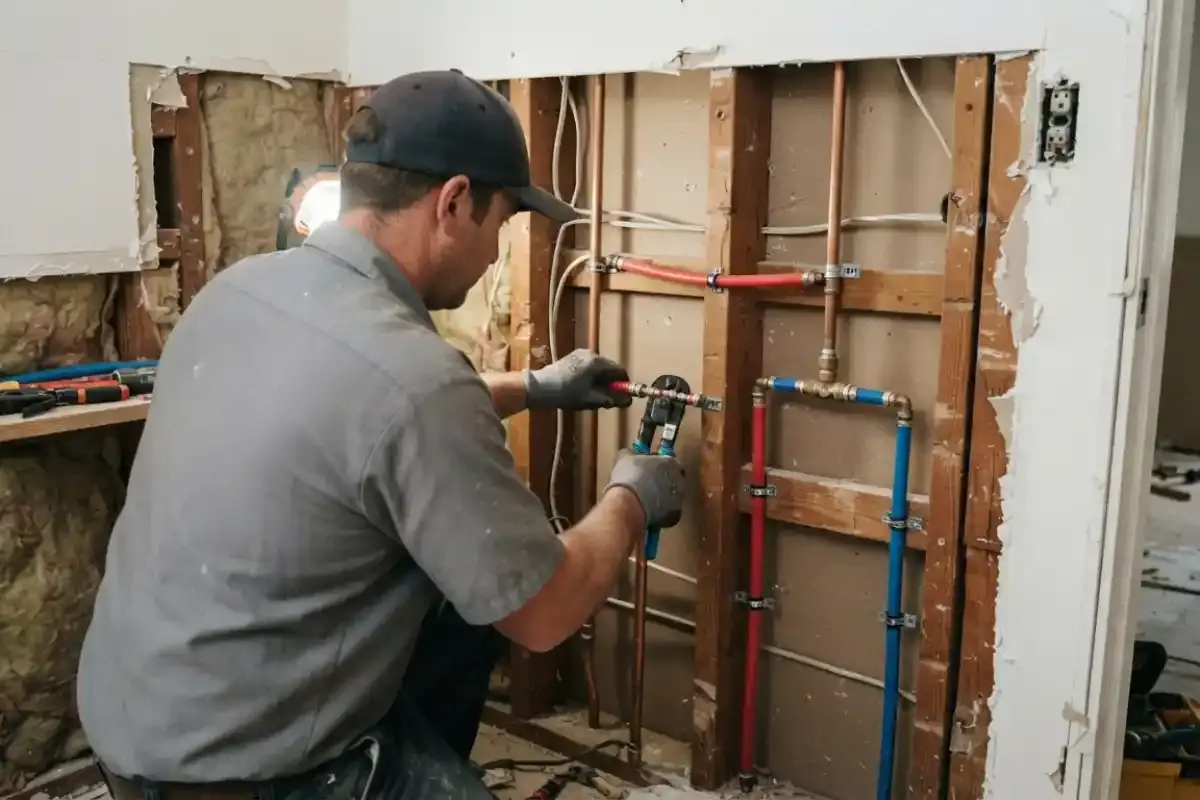
Why slab houses are repiped differently
In a house with a crawlspace, a plumber can crawl under and replace lines in the open. On a slab, many of the water lines run in or under the concrete. Reaching a failing line there means breaking the floor.
That is why most slab repipes abandon the old lines and run new ones overhead or inside walls, where they are easy to reach. The old pipe stays in place, capped and unused. The result is plumbing you can service later without a jackhammer.
Signs the pipes are reaching the end
Repeat pinhole leaks
A second or third leak in a few years usually means the pipe wall is thinning everywhere, not just at one spot.
A warm patch on the floor
Warmth under tile or carpet can mean a hot line leaking beneath the slab.
A meter that moves when nobody is home
Turn off every fixture and watch the meter. Then close the house valve and check again, as ACWD suggests. Movement with the valve closed means the leak is outside the house plumbing, and no movement points inside.
Rusty or metallic first draw
Brown water that clears after a minute points to corroding steel or old fittings.
Falling pressure that keeps spreading
Galvanized pipe fills from the inside with rust, so pressure drops at more fixtures over time.
Water running sounds at night
A hiss or trickle when every fixture is off is worth chasing with listening equipment.
Repair, reroute or repipe: how to decide
| Situation | Usual best move | Why |
|---|---|---|
| One confirmed leak, rest of the pipe sound | Spot repair | Least disruption when the remaining pipe is healthy |
| Leak on a single line under the slab, house otherwise sound | Reroute that line overhead | Avoids breaking concrete and gives you an accessible line |
| Second or third leak on the same material | Plan a full repipe | Leaks cluster as the pipe thins throughout |
| Galvanized steel with weak flow | Repipe | Corrosion inside the pipe cannot be cleaned out |
| Walls already open for a remodel | Repipe while access is open | The access work is already paid for |
A leak detection visit with acoustic listening equipment shows where the leak is before you choose the size of the job.
Water meter spinning and not sure why?
Describe what you are seeing. A plumber can tell you whether it sounds like a spot repair or something bigger.
What a slab-house repipe involves
Map the lines
The plumber finds the main shutoff, traces which fixtures feed from which branch and notes what is under the slab.
Choose the route
New lines go through the attic or inside walls. The route depends on the floor plan and what is above the ceiling.
Open small access points
Drywall is cut near fixtures and along the new path. Ask who patches and paints, because scopes differ.
Run and connect the new lines
PEX or copper goes in, fixtures are reconnected and the old slab lines are capped.
Pressure test and restore
The system is pressurized and checked with a gauge for drops before walls are closed.
Pipe age and ownership in Union City
The Alameda County Water District says homes built before 1960 likely have a galvanized steel service line, which tends to leak after 40 to 50 years. Warning signs include low pressure, a green patch in the lawn and stains. ACWD owns the pipe on the street side of the meter, and you own everything from the meter inward, so ask any bidder whether the new plumbing starts at the meter or at the house wall.
The city's published guidance says a permit is needed for most construction, and replacing concealed defective pipe counts as new work needing a permit and inspection. It does not name repipes, so call the Building Division at 510.675.5313 before you sign and ask who pulls the permit.
New supply piping has to meet the California Plumbing Code, which is based on the Uniform Plumbing Code (UPC), including approved pipe materials, fittings and pressure testing. Ask a contractor to name the pipe material and how the system will be tested, because that answer shows whether the quote follows code.
Source type: ACWD galvanized service line page and City of Union City permit guidance
What moves the price of a slab repipe
Before you sign a repipe contract
- A written scope that lists every line replaced, including hose bibs and the ice maker line
- The material named, and whether any fittings are left from the old system
- Where the new plumbing connects, at the meter side or inside the house
- Who pulls the permit and who schedules the inspection
- Who patches drywall and who paints
- A plan for the days the water will be off
- A contractor license that checks out with the CSLB, which California requires for work valued at one thousand dollars or more
Slab repipe questions
Usually yes. The common method abandons the old slab lines and runs new ones overhead or in walls. Some layouts still need a small amount of concrete work, so ask the bidder to explain the route.
Warm spots on the floor, a moving water meter with everything off and the sound of running water point that way. Acoustic leak location confirms it before anyone cuts anything.
PEX is flexible, uses fewer fittings and is faster to run through attics. Copper has a long track record and handles heat and sunlight, but takes more labor. Either works when it is installed correctly, so compare the rest of the bid.
The city says a permit is needed for most construction, and replacing concealed defective pipe is treated as new work needing a permit and inspection. The published document does not name repipes, so ask the Building Division at 510.675.5313.
Expect the water to be off in stretches as lines are cut over, not for the whole job. Ask for the plan in writing, including when you can use the toilets and the kitchen.
Often a spot repair is enough, especially if the rest of the pipe tests sound. If leaks keep coming back or the pipe is galvanized, repiping stops the cycle. If your home is in Fremont, the same decision applies, see our Fremont plumbing page.