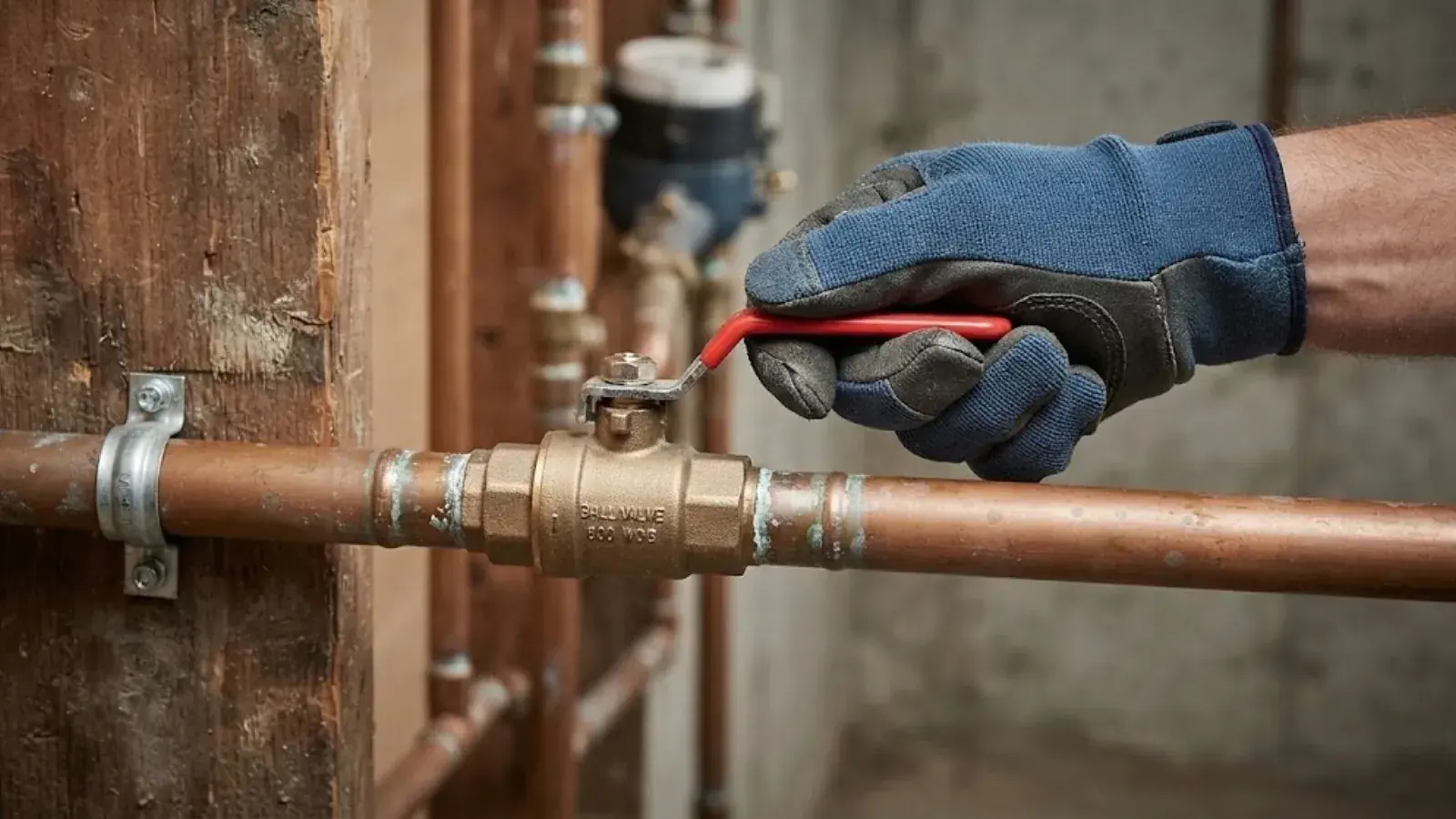
Know These Five Spots Before You Need Them
Main water shutoff
Usually where the water line enters the house, or near the meter. Test it once a year so it turns.
Fixture stop valves
Under sinks and behind toilets. These let you isolate one fixture without losing water to the house.
Water heater shutoff
The cold supply valve above the heater, and the gas control or breaker.
Gas shutoff
Know where the meter valve is and that only a utility or qualified person should reopen it.
Sewer cleanout
Where the drain line can be accessed outside. Knowing it saves time in a backup.
If a Pipe Is Spraying or Flooding
Shut off the water
Turn a round gate valve clockwise until it stops, or turn a lever handle a quarter turn. Open a low faucet to drain pressure.
Keep clear of electricity
If water is near outlets or the panel, stay clear and never touch a breaker while standing in water. Tell the plumber or an electrician about it.
Contain and photograph
Move belongings, mop what you can and take photos for any insurance claim.
Call a plumber
Once the water is off, the problem is stable. Call the 24/7 line and describe what you see.
Local Numbers and Rules Worth Saving
If you smell gas, leave the building, avoid anything that could spark, and call 911. Then call PG&E at 1-800-743-5000. Do not stay to look for the source or try to repair a gas leak yourself.
ACWD is responsible for pipes on the street side of the water meter, and you own the pipe from the meter inward. A leak at or beyond the meter on your side is yours to fix. For a leak on the street side, ACWD Operations is at (510) 668-6500.
California requires water heaters to be braced or strapped against earthquake motion (Health and Safety Code 19211), and the 1868 Hayward Fault earthquake ruptured from Warm Springs in Fremont to San Leandro. Look at your heater now. If the straps are loose or missing, that is a quick fix worth making.
Before any digging, call 811 at least two working days ahead. It is free, and in California it is the law.
The safety steps above are habits, not a substitute for code. Fixed plumbing in California follows the California Plumbing Code, which is based on the Uniform Plumbing Code (UPC), so work such as relocating a gas line, adding a shutoff or changing a water heater should be done and inspected to that standard, not improvised.
Source type: PG&E safety guidance, ACWD, USGS, USD, California Health and Safety Code 19211, USA North 811
A Quick Home Safety Walk
- Test your main shutoff by closing and reopening it gently.
- Look under every sink for drips, rust or swollen cabinet floors.
- Check the water heater for rust at the base, scorching and loose straps.
- Know the smell of gas and keep the utility numbers on your phone.
- Check flexible hoses on washers and toilets for bulges or cracks.
- Keep grease and wipes out of the drain, even labeled flushable ones.
Do this walk twice a year, perhaps when you change smoke alarm batteries. Ten minutes is enough, and it is how most slow leaks get caught before they stain a ceiling.
Water Heater and Drain Safety
A water heater is the one appliance in the house that stores a large volume of hot water under pressure. Keep the area around it clear, look for rust at the base, and never block or cap the relief valve discharge pipe. A setting around 120 degrees Fahrenheit is commonly recommended to limit scalding.
Hoses deserve a mention too. Rubber washing machine hoses harden and split with age, so replace them with braided lines every few years and turn the washer valves off when you leave for a trip. A burst hose can put out a lot of water in an hour.
Chemical drain cleaners are another hazard. They can burn skin and eyes, damage older pipes and leave a plumber working in caustic water later. If a plunger does not clear it, stop and call.
Found a leak and not sure how bad?
Call and describe it. A plumber can help you decide whether it can wait until morning.
Safe DIY or Call a Plumber
Reasonable DIY
- Closing fixture stops and the main valve
- Replacing a faucet aerator or a toilet flapper
- Clearing a sink with a plunger
- Checking water heater straps
Call a plumber
- Any gas smell or gas line work, after calling 911 and PG&E
- A leak that continues after the shutoff is closed
- Water heater relief valve discharging repeatedly
- Discolored water, sewer smells or backups
Leaks You Cannot See
A hidden leak is a safety issue as well as a cost one, since constant moisture invites mold and rot. Our leak detection service finds them with listening gear and cameras. If a heater is leaking or acting up, our water heater repair page explains what we check.
We also take these calls from Fremont and the nearby Tri-City area, with the same 24/7 line.
Plumbing Safety Questions
Usually where the water line enters the house, often at the front near the meter, in a garage or on an outside wall. Find it before you need it and make sure it turns.
Leave the building right away, avoid ignition sources, call 911, then call PG&E at 1-800-743-5000. Do not try to find the source yourself.
Yes. Close the cold supply valve and switch off the gas control or breaker. Leave repairs to a plumber.
Use your own main valve first. The meter is ACWD's equipment, so call ACWD Operations at (510) 668-6500 if the leak is on the street side or the main valve fails.
USD's 24 hour line is (510) 477-7500. USD checks the public main for free. If it is clear, the blockage is probably in your own lateral.